

Learning Spanish is not just about studying vocabulary or memorizing grammar rules. To understand how well you really know the language, there is an international scale known as the CEFR, the Common European Framework of Reference for Languages.
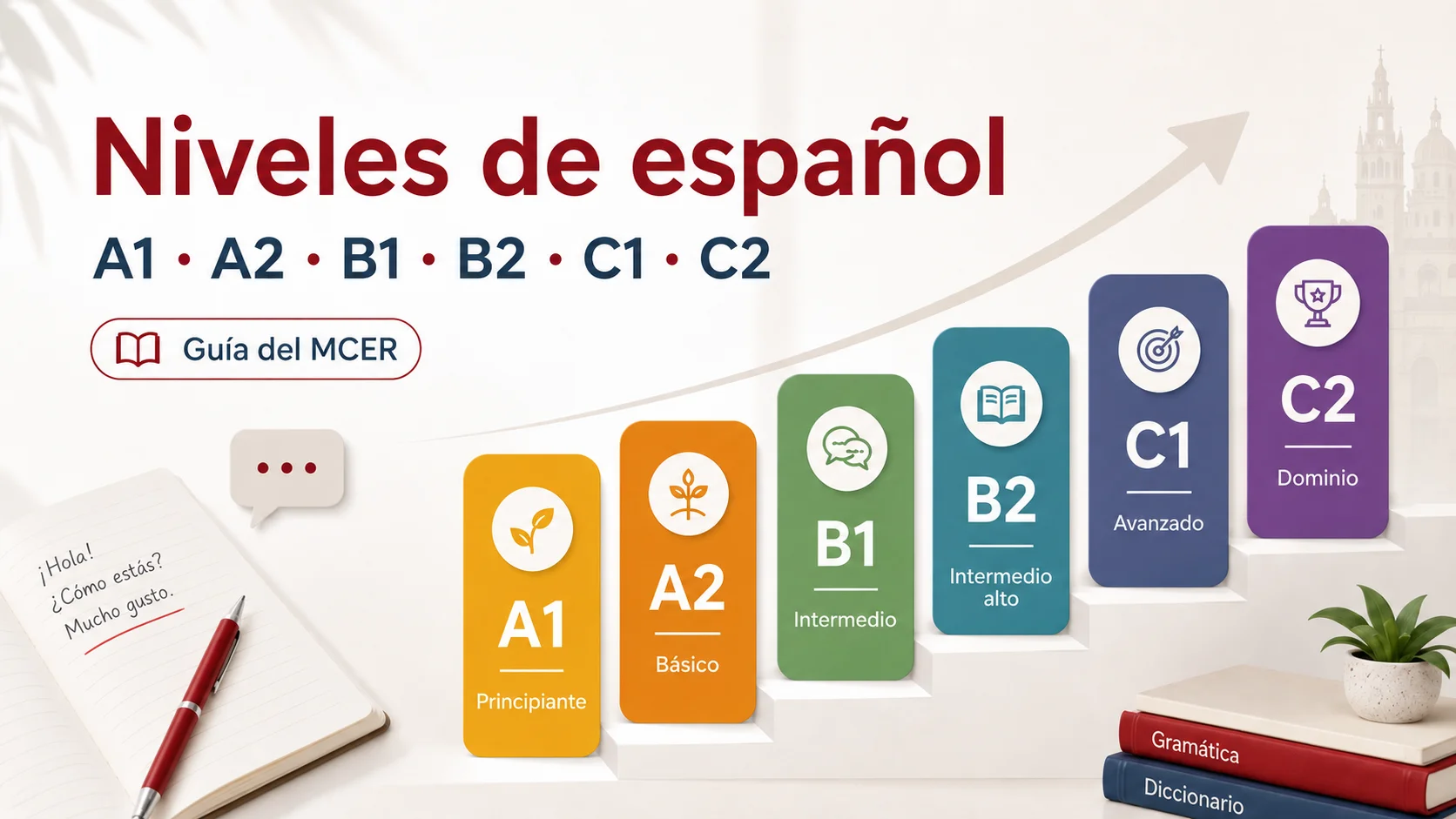
This framework divides language learning into six levels: A1, A2, B1, B2, C1, and C2. Each level describes what a person can understand, say, write, and do in Spanish in real-life situations.
In this guide, we explain what each Spanish level means, what skills are developed at each stage, and how you can find out your current level.
What Is the CEFR?
The CEFR, or Common European Framework of Reference for Languages, is an international system used to describe language proficiency.
In Spanish, the CEFR helps classify students according to their ability to communicate in different contexts: introducing themselves, having a conversation, understanding texts, writing emails, debating, working in Spanish, or studying at a Spanish-speaking university.
The framework establishes six main levels: A1, A2, B1, B2, C1, and C2. These levels range from beginner users to highly advanced or proficient users.
Summary Table of Spanish Levels
| Level | Type of user | What It Means | What You Can Do |
|---|---|---|---|
| A1 | Beginner | You can communicate in very simple situations. | Introduce yourself, greet people, ask for basic information, and use simple phrases. |
| A2 | Elementary | You can talk about everyday topics and understand simple messages. | Talk about routines, likes, family, shopping, travel, and simple experiences. |
| B1 | Intermediate | You can manage with some independence in many real-life situations. | Talk about experiences, express simple opinions, and deal with travel situations. |
| B2 | Upper - Intermediate | You can communicate fluently and defend your point of view. | Argue, take part in conversations, write clear texts, and understand more complex topics. |
| C1 | Advanced | You can use Spanish flexibly, effectively, and accurately. | Understand long texts, express yourself fluently, and adapt your language to the context. |
| C2 | Proficient | You can express yourself with great precision in almost any situation. | Understand almost everything, use nuances, debate, and write complex texts naturally. |
A1 Spanish Level: Beginner
A1 is the first level of Spanish according to the CEFR. It is the starting point for people who are learning the language from scratch or who have very basic knowledge. At this level, you can understand and use simple expressions related to immediate needs.
What Can You Do with an A1 Level in Spanish?
- Introduce yourself and give basic information about yourself.
- Ask and answer questions about personal details.
- Talk about your nationality, profession, family, or place of residence.
- Understand simple phrases if the other person speaks slowly.
- Buy something, order in a café, or greet people in a basic way.
- Write very simple messages.
Examples of A1-Level Sentences
- “My name is Anna.”
- “I am from Germany.”
- “I live in Madrid.”
- “I want a coffee, please”
- “Where is the bathroom?”
Who Is A1 For?
A1 is ideal for students who are starting Spanish for the first time and want to build a solid foundation to communicate in very simple situations.
A2 Spanish Level: Elementary
A2 is still a basic level, but the student can already communicate with more confidence in everyday situations. At this level, you no longer use only isolated phrases; you begin to connect ideas and talk about familiar topics.
What Can You Do with an A2 Level in Spanish?
- Talk about routines, likes, and daily activities.
- Describe people, places, and objects.
- Talk about simple past experiences.
- Make plans and talk about the near future.
- Understand short conversations about familiar topics.
- Write simple messages, notes, or emails.
Examples of A2-Level Sentences
- “I usually work in the morning.”
- “This weekend I went to the movies with my friends.”
- “Tomorrow I am going to study Spanish.”
- “I like to travel because I can experience other cultures.”
Difference Between A1 and A2
The main difference between A1 and A2 is that at A1 the student communicates using very basic phrases, while at A2 they can talk about daily life in more detail and understand simple conversations.

B1 Spanish Level: Intermediate
B1 marks an important step forward. From this level, the student begins to manage with a certain degree of independence. This means they can communicate in many real-life situations, although they may still make mistakes or need time to organize their ideas.
What Can You Do with a B1 Level in Spanish?
- Hold conversations about familiar topics.
- Talk about experiences, trips, anecdotes, and plans.
- Express simple opinions.
- Explain wishes, needs, and reasons.
- Deal with situations while traveling.
- Understand clear texts about common topics.
- Write simple and coherent texts.
Examples of B1-Level Sentences
- “When I arrived in Spain, I had trouble understanding people, but now I feel more confident.”
- “I think living in another country is a very positive experience because you learn a lot.”
- “If I had more time, I would study Spanish every day.”
Why Is B1 Important?
B1 is often a key level for students who want to use Spanish in daily life, travel, work in basic contexts, or prepare for official exams. In some administrative procedures, it may also be necessary to prove a specific level of Spanish through official exams such as DELE, depending on the case and the country.
B2 Spanish Level: Upper-Intermediate
B2 is one of the most requested Spanish levels by students, companies, and universities. A person with a B2 level can communicate fluently, understand more complex texts, and defend their point of view on different topics.
What Can You Do with a B2 Level in Spanish?
- Take part in conversations with native speakers with a good degree of naturalness.
- Defend opinions and argue a point.
- Understand news, articles, and specialized texts if you know the topic.
- Write clear and detailed texts.
- Explain advantages, disadvantages, and points of view.
- Manage in academic or professional environments.
Examples of B2-Level Sentences
- “From my point of view, learning a language doesn't just depend on grammar, but also on constant practice.”
- “Although many people prefer to study online, in-person classes can offer a closer experience.”
- «One of the main advantages of living in Spain is the opportunity to practice the language every day.”
Difference Between B1 and B2
The difference between B1 and B2 is mainly fluency, accuracy, and the ability to argue. A B1 student can communicate, but usually with simpler structures. A B2 student can explain more complex ideas, take part in discussions, and express themselves more naturally.
C1 Spanish Level: Advanced
C1 corresponds to an advanced user. At this level, the student can use Spanish flexibly, effectively, and accurately in social, academic, and professional contexts. It is no longer just about “communicating”, but about choosing the right words, adapting the tone, and understanding implied meanings.
What Can You Do with a C1 Level in Spanish?
- Understand long and complex texts.
- Express yourself fluently without constantly searching for words.
- Use Spanish in meetings, university studies, or qualified jobs.
- Write well-structured texts.
- Use connectors, nuances, and different registers.
- Understand irony, double meanings, and common idiomatic expressions.
Examples of C1-Level Sentences
- “It's not just about mastering grammar, but about being able to adapt your speech to the context and the person you're speaking with.”
- “Despite the many advantages of autonomous learning, instructor guidance can significantly accelerate progress.”
- “It's worth noting that fluency doesn't always imply accuracy.”
Who Is C1 For?
C1 is recommended for people who want to study at a Spanish university, work in a demanding professional environment, or certify an advanced command of the language.
C2 Spanish Level: Proficient
C2 is the highest level of Spanish according to the CEFR. It does not necessarily mean “being native”, but it does imply a very high ability to understand and express yourself in almost any situation. A person with a C2 level can communicate with great precision, naturalness, and linguistic richness.
What Can You Do with a C2 Level in Spanish?
- Understand almost everything you read or hear.
- Express yourself spontaneously, precisely, and fluently.
- Use nuances, irony, humor, and cultural references.
- Write complex texts with your own style.
- Reformulate ideas with precision.
- Take part in demanding debates or specialized professional contexts.
Examples of C2-Level Sentences
- “What's interesting isn't just what is said, but how the discourse is articulated and what nuances each linguistic choice conveys.”
- “That comment, though seemingly innocent, reveals a much more complex stance than it appears at first glance.”
- “The challenge of the C2 level is not to speak a lot, but to speak with precision, naturalness, and appropriateness.”
How Can You Know Your Spanish Level?
To know your Spanish level, the best option is to take a level test that evaluates different skills: reading comprehension, listening comprehension, writing, speaking, grammar, and vocabulary. Knowing a lot of grammar or understanding Spanish series is not enough. Your real level depends on what you are able to do with the language in communicative situations.
- Signs that you have an A1 or A2 level. You probably have an A1 or A2 level if you can introduce yourself, talk about routines, order food, do simple shopping, or have very basic conversations.
- Signs that you have a B1 or B2 level. You probably have a B1 or B2 level if you can talk about experiences, give opinions, understand normal conversations, and manage in travel, study, or work situations with some independence.
- Signs that you have a C1 or C2 level. You probably have a C1 or C2 level if you can debate, understand complex texts, adapt your language to the context, and express yourself accurately in academic or professional situations.
What Spanish Level Do You Need?
The level of Spanish you need depends on your goal. If you want to travel or communicate in basic situations, an A1 or A2 level may be enough. If you want to live in a Spanish-speaking country and manage with autonomy, it is advisable to reach at least B1 or B2. If you want to study at a university, work in a qualified position, or prove an advanced command of the language, you will usually need B2, C1, or even C2. Below, we share some observations based on our experience and the guidelines of the Instituto Cervantes:
- For travel: A2 or B1.
- For living in Spain or Latin America: B1 or B2.
- For working in Spanish: B2 or C1, depending on the position.
- For studying at a university. Recommended level: B2 or C1. Our Spanish + University Access course helps students prepare for this requirement, as many universities ask for it as part of the admission process.
- To prepare for an official exam. it depends on the exam and your goal.
What Is the Difference Between a Spanish Level and an Official Certificate?
Your Spanish level is your real ability to use the language. An official certificate is a document that proves that level before institutions, universities, companies, or public administrations. You can have a good level of Spanish without a certificate, but if you need to prove it officially, you will have to take a recognized exam, such as DELE or SIELE.
Tips to Improve Your Spanish Level
Study consistently, even if it is only a little time each day. Practice conversation from the first levels. Listen to real Spanish through videos, podcasts, or classes. Read texts adapted to your level. Write short texts and ask for corrections. Above all, follow a clear learning plan.
To move from one level to another, it is important to work on all language skills: speaking, listening, reading, writing, grammar, and vocabulary. Learning Spanish is not only about studying rules. You also need to practice in real contexts and receive corrections to improve. This is what we do in our courses with our students. If you want to learn more and see how we can help you, contact us and we will give you personalized guidance.
This is what we do in our courses with our students. If you want to learn more and see how we can help you, contact us and we will give you personalized guidance.
Conclusion: Spanish Levels Help You Measure Your Progress
The levels A1, A2, B1, B2, C1, and C2 help you understand where you are and what you need to learn in order to keep improving. The CEFR is useful because it does not only measure the grammar you know, but also your ability to use Spanish in real situations. That is why knowing your level is the first step toward choosing the right course, preparing for an official exam, or improving your communication. At PCE Spanish School, this is what we do before each student starts a course.
Frequently Asked Questions About Spanish Levels
- What are the Spanish levels? The Spanish levels according to the CEFR are A1, A2, B1, B2, C1, and C2. A1 is the beginner level and C2 is the most advanced level.
- What Does It Mean to Have an A1 Level in Spanish? Having an A1 level means that you can communicate in a very basic way: introduce yourself, give personal information, greet people, ask for simple things, and understand simple phrases.
- What is the difference between A2 and B1? The main difference is autonomy. At A2, you can communicate in simple everyday situations. At B1, you can manage in more real-life situations, talk about experiences, and express basic opinions.
- What Spanish level do I need to work? To work in Spanish, a B2 or C1 level is usually recommended, although it depends on the type of job. For positions with a lot of oral or written communication, C1 may be more suitable.
- What Spanish Level Do I Need to Study in Spain? Many universities usually require B2 or C1, although it depends on the institution, the program, and the specific admission requirements.
- Is C2 the same as being native? Not exactly. C2 is the highest CEFR level and shows very advanced competence, but being native also involves cultural and linguistic experience acquired from childhood.
- How can I know my Spanish level? You can know your level by taking a level test that evaluates comprehension, speaking, writing, grammar, and vocabulary. Ideally, it should be combined with an oral interview.
- What is the best level for taking the DELE exam? It depends on your goal. If you need to prove your Spanish for studies, work, or administrative procedures, you should choose the level required by the institution. If you are not sure about your level, it is best to take a test before registering.