
At PCE Spanish School, one of the most frequently asked questions students ask before starting a course is: “How long will it take me to learn Spanish?”
The honest answer is: it depends. A person who wants to learn Spanish for travel will not need the same amount of time as someone who needs a B2 level to study at university, prepare for an official exam, or work in Spanish.
Also, learning Spanish doesn't just depend on the number of class hours. Your native language, your experience learning lanAlso, learning Spanish does not depend only on the number of class hours. Your native language, your previous experience learning languages, study frequency, speaking practice, motivation, and the type of course you take also play an important role.
In this guide, we explain how long it may take to learn Spanish depending on your starting level, your goals, and the levels of the Common European Framework of Reference for Languages, known as the CEFR. The CEFR organizes language proficiency into six main levels: A1, A2, B1, B2, C1, and C2.guages, study frequency, oral practice, motivation, and the type of course you take also play a role.
Can You Know Exactly How Long It Takes to Learn Spanish?
It cannot be calculated exactly for every student, but realistic estimates can be made.
As a general reference, some educational institutions calculate the guided learning hours needed to progress from one level to another. Cambridge English, for example, estimates that moving from one CEFR level to the next can require approximately 200 hours of guided learning,although this figure varies depending on the student, the language, and the learning context.
In the case of Spanish, some Instituto Cervantes centers also organize their courses by levels and hours. For example, the Instituto Cervantes in Leeds structures its academic program with approximately 60 hours for A1, 90 hours for A2, 120 hours for B1, 150 hours for B2, and 180 hours for C1.
That is why the most important thing is not to obsess over an exact number, but to understand that progress depends on a combination of study hours, course quality, and real practice.
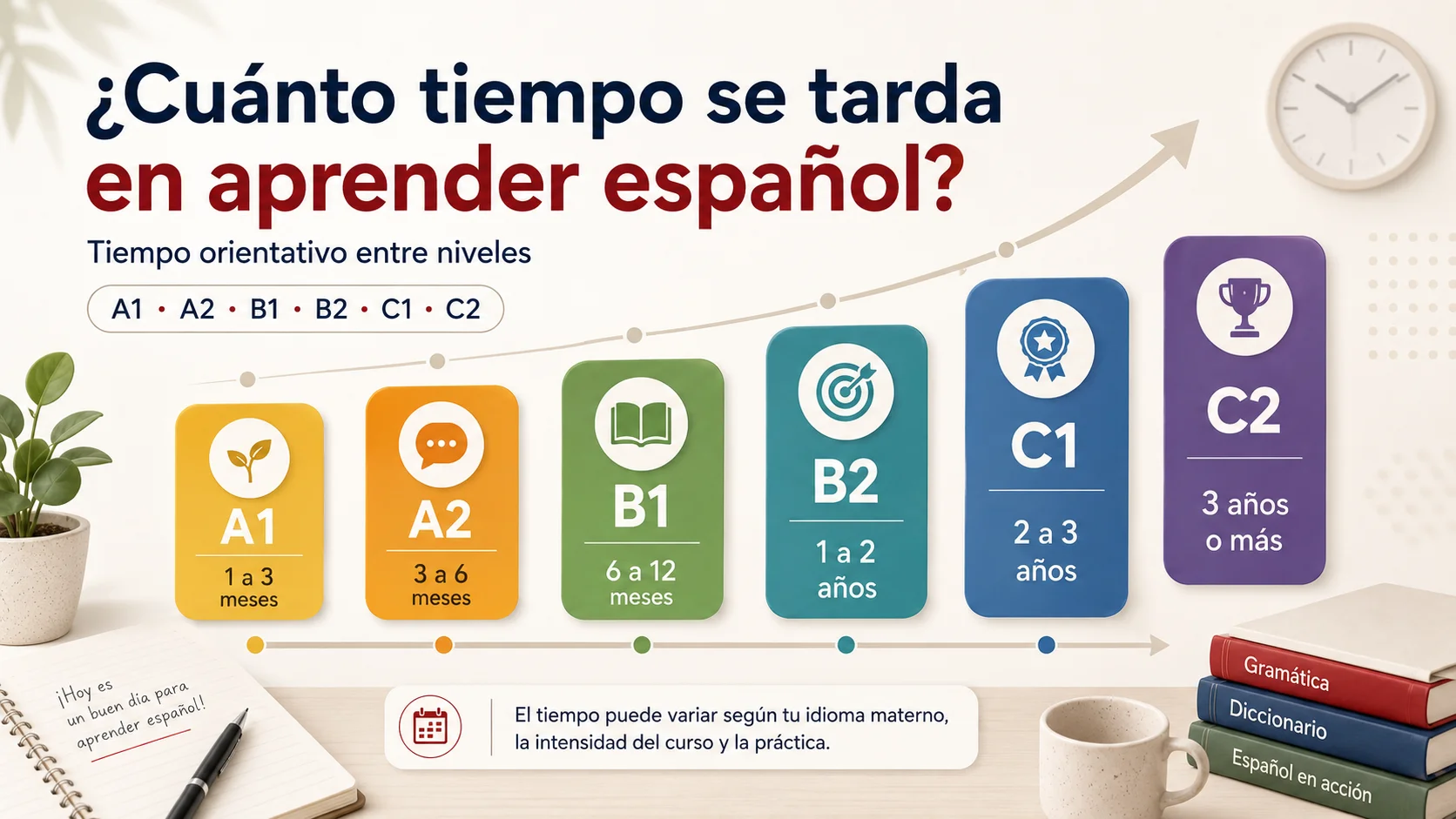
Guide Table: How Long Does It Take to Learn Spanish by Level?
This table is an approximate reference. It can vary greatly depending on your native language, your study pace, your exposure to Spanish, and your goals.
| Goal | Approximate level | Estimated time | What you can do |
|---|---|---|---|
| Learn basic travel phrases | A1 | 1 to 3 months | Introduce yourself, greet, order food, ask for directions, and use simple phrases. |
| Communicate in everyday situations | A2 | 3 to 6 months | Talk about routines, likes, shopping, travel, family, and simple experiences. |
| Communicate with some autonomy | B1 | 6 to 12 months | Hold conversations about familiar topics, recount experiences, and resolve real-life situations. |
| To speak fluently and study or work | B2 | 1 to 2 years | Give arguments, participate in conversations, understand complex texts, and write clearly. |
| Using Spanish in professional or academic contexts | C1 | 2 to 3 years | Express yourself fluently, understand long texts, and adapt your language to the context. |
| Master the language with great precision | C2 | 3 years or more | Use nuances, debate, understand almost everything, and write complex texts naturally. |

How Long Does It Take to Reach an A1 Level of Spanish?
A1 is the first level of the CEFR. It is the starting point for learning a language. A person with an A1 level can introduce themselves, greet others, ask for basic information, talk about personal details, and understand simple sentences if the other person speaks slowly. As a guideline, you can reach an A1 level in 1 to 3 months if you study regularly. If you take an intensive course, you can progress faster. If you only study once a week, you will probably need more time.
With A1, you can:
- Introduce yourself.
- State your nationality, profession, and place of residence.
- Order food or drink.
- Ask very basic questions.
- Understand simple sentences.
- Write very short messages.
A1 can be enough if you want to have your first contact with Spanish, travel with basic phrases, or start from scratch before moving on to more practical levels.
How Long Does It Take to Reach an A2 Level of Spanish?
A2 is still considered a basic level, but it already allows you to communicate more effectively in everyday situations. Someone with an A2 level can talk about routines, preferences, family, shopping, travel, daily activities, and simple experiences. To reach A2 from scratch, you may need approximately 3 to 6 months of consistent study. If you already have a foundation in Spanish or speak a related language, such as Italian, Portuguese, or French, you may progress more quickly.
With A2, you can:
- Talk about your day-to-day life.
- Explain likes and preferences.
- Go shopping.
- Book accommodations.
- Talk about simple plans.
- Share simple past experiences.
The A2 level can be useful for traveling, spending a short time in a Spanish-speaking country, or communicating in simple situations.
How Long Does It Take to Reach a B1 Level of Spanish?
B1 is a very important milestone because it marks the step toward autonomy. With B1, you can already manage in many real-life situations. You can talk about experiences, express simple opinions, discuss plans, and solve situations during a trip. To reach B1 from scratch, many students need between 6 and 12 months,depending on the intensity of the course and the practice they do outside class. If you study several hours a week and practise conversation, you can progress more quickly. If you only study occasionally, the process will be longer.
- Hold conversations about familiar topics.
- Share personal experiences.
- Explain plans and wishes.
- Give simple opinions.
- Solve everyday problems.
- Understand clear texts on familiar topics.
B1 is recommended if you want to live in Spain or Latin America with some autonomy, work in basic contexts, or prepare for certain official exams.
How Long Does It Take to Reach a B2 Level of Spanish?
B2 is one of the most in-demand levels. Many people need it for studying, working, or demonstrating a good command of the language. With B2, you can communicate fluently, understand more complex texts, and defend your point of view. To reach B2 from zero, it usually takes between 1 and 2 years of consistent study. The B2 level requires more than just knowing grammar. You need to speak naturally, understand different accents, write clear texts, and argue your ideas.
With a B2, you can:
- Participate in conversations with native speakers.
- Defend your opinions.
- Explain advantages and disadvantages.
- Understand news and complex texts.
- Write clear and detailed texts.
- Function effectively in academic or professional settings.
The B2 level is recommended if you want to study at a university, work in Spanish, or have a solid foundation for living in a Spanish-speaking country.
How Long Does It Take to Reach a C1 Level of Spanish?
C1 is an advanced level. At this point, the student does not simply communicate: they use Spanish flexibly, precisely, and effectively. With C1, you can understand long texts, participate in debates, write complex documents, and adapt your language to the context. To reach C1 from zero, you may need approximately 2 to 3 years, although this depends greatly on your pace, exposure to the language, and real practice. C1 requires deeper work: nuances, connectors, specific vocabulary, idiomatic expressions, grammatical accuracy, and oral fluency.
With C1, you can:
- Express yourself fluently.
- Understand long and complex texts.
- Using Spanish in university studies.
- Working in professional environments.
- Write well-structured texts.
- Understand nuances and implicit meanings.
C1 is recommended if you need Spanish for higher education, skilled work, research, teaching, or advanced professional communication.
How Long Does It Take to Reach a C2 Level of Spanish?
C2 is the highest level of the CEFR. It does not necessarily mean speaking like a native speaker in every context, but it does imply a very high command of the language. With C2, you can understand virtually everything, express yourself with great precision, and adapt your speech to very complex situations. Reaching C2 may require 3 years or more of study, practice, and immersion.At this level, progress tends to be slower because it is no longer just about “speaking well,” but about expressing yourself naturally, with richness, precision, and style.
With a C2, you can:
- Understand very complex texts.
- Express yourself spontaneously and accurately.
- Use irony, humor, and nuance.
- Write sophisticated texts.
- Take part in demanding debates.
- Adapt your Spanish to formal, academic, or professional contexts.
Factors That Influence the Time It Takes to Learn Spanish
The time it takes to learn Spanish depends on various factors. Two students can start on the same day and progress at very different rates.
- Your native language. If your mother tongue is close to Spanish, such as Italian, Portuguese, French, or Romanian, you will probably recognize many structures and words. If your language is very different, such as Chinese, Arabic, Japanese, or Russian, you may need more time to adapt to the grammar, sounds, and vocabulary.
- Your experience learning languages. A person who has already learned other languages usually has more strategies: they know how to study vocabulary, understand grammar better, and lose their fear of speaking more quickly.
- Study frequency. Studying once a week is not the same as studying four or five days a week. Consistency is more important than cramming many hours into a single day.
- Speaking practice. Many people understand Spanish, but they do not speak it with confidence. To truly progress, you need to practise conversation from the beginning.
- Language exposure. Watching series, listening to podcasts, reading adapted texts, speaking with native speakers, or living in a Spanish-speaking country can greatly accelerate learning.
- Your goal. You do not need the same level to travel for a week as you do to study Medicine at a Spanish university, have a job interview, or pass a DELE B2 exam.
How Much Time Do I Need If I Want to Learn Spanish for Travel?
If your goal is to travel, you do not need to wait until you have an advanced level. With an A1 or A2 level, you can already handle many basic situations: ordering food, buying tickets, asking for directions, booking accommodation, or introducing yourself.
- To travel with useful phrases, you may need between 1 and 3 months.
- To travel with more confidence, talk about routines, and solve everyday situations, it is recommended to reach A2, which may require between 3 and 6 months.
How Much Time Do I Need to Live in Spain or Latin America?
To live in a Spanish-speaking country, it is ideal to have at least a B1 level. With B1, you can handle many situations: paperwork, shopping, transport, housing, basic conversations, doctor’s appointments, or social interactions. To live with some autonomy, you may need between 6 and 12 months of consistent study. If you are also immersed in the language and practise every day, you can progress faster.
How Much Time Do I Need to Work in Spanish?
To work in Spanish, you will usually need a B2 to C1 level, depending on the position. Working in customer service, education, marketing, sales, medicine, law, or administration is not the same as working in an environment where you only need basic conversations. To reach B2, you may need 1 to 2 years. To reach C1, you will usually need more time, specialized practice, and professional vocabulary. If your goal is professional, it is also advisable to work on professional Spanish: emails, meetings, presentations, calls, interviews, and vocabulary specific to your industry.
How Long Do I Need to Study at a Spanish University?
To study at a Spanish university, the usual requirement is a B2 or C1 level, depending on the university, degree, and admission requirements. It is not enough to speak Spanish in everyday situations. You also need to understand classes, read academic texts, write papers, give presentations, and take exams.
How Much Time Do I Need to Prepare for an Official Exam?
If you want to prepare for an official exam such as DELE or SIELE, the time will depend on your current level and the level you want to certify. Preparing for a DELE A2 is not the same as preparing for a DELE B2 or C1. The higher the level, the more time you will need to consolidate grammar, vocabulary, and oral and written expression. If you already have the level, you may need between 1 and 3 months of specific preparation to become familiar with the exam format, practise with sample tests, and correct errors. If you do not yet have the level, you will first need to reach it and then prepare for the exam.
Can you prepare and inform us about our DELE / SIELE courses.
How to Learn Spanish Faster
There is no magic formula, but there are ways to progress more effectively. Based on our experience, we recommend the following:
- Study regularly. It is better to study for 30 or 45 minutes several days a week than to study for many hours only one day.
- Speak from the beginning. Do not wait until you “know enough.” Speaking is a skill that is trained through practice.
- Combine classes and practice. Classes give you structure, correction, and progression. Practice gives you fluency and confidence.
- Learn useful vocabulary. Do not memorize huge lists without context. Learn words and expressions you can use in real life.
- Receive corrections. You can progress on your own, but it is easy to repeat mistakes without realizing it. A teacher can help you correct them sooner.
If you want to take Spanish classes adapted to your level and needs, contact us or visit our Spanish courses.
How Long Does It Take to Go from Zero to C2 in Spanish?
We have received this question several times. The truth is that reaching a C2 level is a long-term goal and is not realistic for every learner. In many cases, reaching C2 requires years of study, frequent use of the language, and a high level of exposure to Spanish. Living in a Spanish-speaking country or using Spanish regularly in academic or professional contexts can make a major difference. Under very favorable conditions, reaching a C2 level may take several years. For many learners, it can take much longer than reaching B2 or C1, because C2 requires not only fluency, but also precision, nuance, style, and deep comprehension.
Frequently Asked Questions About How Long It Takes to Learn Spanish
- How long does it take to learn Spanish from scratch? It depends on your goal. For basic communication, you may need 1 to 3 months. To reach an intermediate level such as B1 or B2, you will usually need several months or even more than a year of consistent study.
- Can you learn Spanish in 3 months? Yes, you can learn basic Spanish in 3 months, especially if you take an intensive course. However, to speak fluently and understand more complex conversations, you will need more time.
- How long does it take to speak Spanish fluently? To speak Spanish fluently, many people need to reach at least a B2 level. This can require 1 to 2 years of consistent study, although it depends on the intensity of the course and speaking practice.
- How many hours do I need to learn Spanish? There is no exact figure. As a guideline, moving from one CEFR level to the next can require around 200 hours of guided learning, although the actual time depends on each student.
- Is Spanish difficult to learn? Spanish can be easier for speakers of related languages, such as Portuguese, Italian, or French. Even so, the difficulty depends on your native language, your consistency, your study method, and your practice.
- What level do I need to live in Spain? To live in Spain with some autonomy, it is recommended to reach at least a B1 level. If you want to work or study, you will probably need B2 or C1.
- What level do I need to work in Spanish? To work in Spanish, a B2 or C1 level is usually recommended, depending on the type of position and the communication you need in your job.
- Can PCE Spanish School help me find out my level? Yes. At PCE Spanish School, we can help you identify your current level and recommend a course adapted to your goals.