

At PCE Spanish School, many international students contact us because they want to study in Spain but are unsure about what they need: whether they have to obtain official recognition of their qualifications, take the PCE exams, prove their Spanish level or request any documentation through UNEDasiss.
The answer depends largely on the country where you studied and the education system you come from. The process is not the same for students from a European Union country or an education system with a reciprocity agreement as it is for students from an education system without one.
In this guide, we explain in simple terms the main requirements for studying at a Spanish university as an international student and what you should consider before starting your preparation.
Can I study at a Spanish university if I studied outside Spain?
Yes. International students can access Spanish universities if they meet the necessary academic requirements and follow the corresponding admissions process.
In many cases, the process is carried out through UNEDasiss, a UNED service that assesses the academic records of international students and manages the procedures and examinations required to access undergraduate studies in Spain.
In addition, each university may establish its own admissions criteria. For this reason, before choosing subjects or preparing for exams, it is important to check the requirements of the specific university and degree programme you want to apply for.
Types of international students
Broadly speaking, we can distinguish between two main profiles:
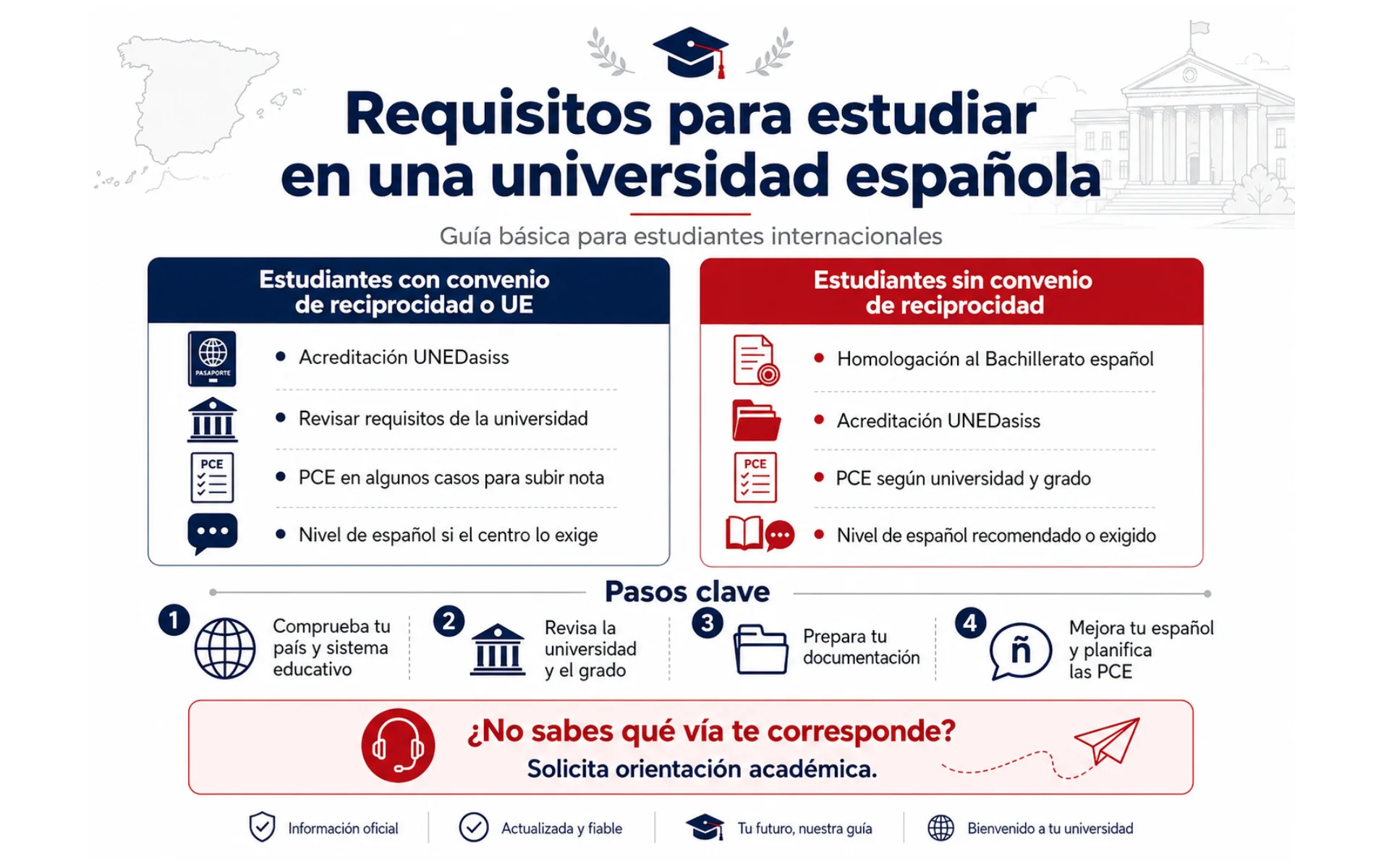
- Students from the European Union or education systems with a reciprocity agreement.
- Students from education systems without a reciprocity agreement.
This distinction is important because it can affect the admissions process, the documents you need and the number of PCE subjects you may need to prepare.
Students from the European Union or systems with a reciprocity agreement
Students from European Union education systems or countries with a reciprocity agreement may have a different route to university admission, as their qualifications may be recognised for access to university under conditions similar to those of the Spanish education system.
These systems usually include European Union countries, the International Baccalaureate, the European Baccalaureate and countries with reciprocity agreements such as Andorra, Colombia, China, Iceland, Liechtenstein, Norway, the United Kingdom or Switzerland, according to information published by universities such as the Complutense University of Madrid.
What might these students need?
They may normally need:
- UNEDasiss accreditation.
- A university entrance grade.
- To review the admissions criteria of their chosen university.
- In some cases, PCE exams to improve their admission grade or meet admissions requirements.
- Proof of Spanish language level, if required by the university.
For students in this category, PCE exams may not always be compulsory in the same way as they are for other applicants, but they can be very important for improving the admission grade or applying for degree programmes with high entry requirements.
Students from education systems without a reciprocity agreement
Students from education systems without a reciprocity agreement usually need to follow a different route.
In these cases, it is normally necessary to apply for official recognition of their qualifications as equivalent to the Spanish Bachillerato and check which accreditation services or examinations are required by their chosen university.
UNEDasiss states that students from international education systems who meet the requirements for obtaining recognition of their qualifications as equivalent to the Spanish Bachillerato can access university through this route.
What might these students need?
In general, they may need to:
- Obtain official recognition of their secondary school qualifications or Bachillerato equivalent.
- Apply for UNEDasiss accreditation.
- Prepare PCE subjects.
- Check the specific requirements of their chosen university.
- Provide proof of their Spanish level, if required by the institution.
- Prepare translated or legalised academic documents, depending on their circumstances.
This type of applicant usually needs more planning, because wanting to study in Spain is not enough: you need to review documentation, deadlines, qualification recognition, exams and admissions criteria.
What are the PCE exams and when are they required?
The PCE, or Specific Competency Tests, are subject-based exams that international students may take to access a Spanish university or improve their admission grade. You can find more information about the PCE exams in our article.
These exams are linked to UNEDasiss and may be required depending on your education system, the university and the degree programme you choose. UNEDasiss provides information about exams, subjects, examination sessions and test centres.
For example, a student who wants to study Medicine, Engineering, Psychology, Business Administration or Law may need different subjects. This is why choosing the right PCE subjects is a key part of the admissions strategy.
What level of Spanish do I need to study in Spain?
The Spanish level you need depends on the university and degree programme. Some universities may require an official language qualification, especially if the student comes from a non-Spanish-speaking country.
Although universities do not always require the same certificate, having at least a B2 level is generally advisable if you want to study at a Spanish university, particularly if you will need to attend classes, sit exams, read academic texts and participate in lessons.
For many international students, the challenge is not only passing the PCE exams but also understanding questions correctly, studying in Spanish and expressing their answers clearly.
Main requirements for studying at a Spanish university
Although each case should be assessed individually, these are the most common requirements:
1. Have qualifications equivalent to the Spanish Bachillerato. You need to have completed studies that allow you to access university in your country or that can be officially recognised as equivalent to the Spanish Bachillerato.
2. Apply for the appropriate accreditation. Many international students use UNEDasiss to obtain an accreditation that Spanish universities can use in their admissions processes.
3. Check whether you need to take the PCE exams. Depending on your country, university and chosen degree programme, you may need to take PCE exams to meet admissions requirements or improve your grade.
4. Choose the right subjects. Not all subjects are equally useful for every degree programme. Your choice should depend on the degree you want to study and the weighting criteria used by the university.
5. Provide proof of your Spanish level. If you come from a non-Spanish-speaking country, you may need to demonstrate a minimum level of Spanish. Even if this is not formally required, you will still need sufficient Spanish to study successfully.
6. Meet the admissions deadlines. Deadlines for UNEDasiss, qualification recognition, PCE exams and university pre-enrolment may be different. UNEDasiss provides a search tool which, depending on your country and type of studies, shows the accreditation services you may need and links to university admissions criteria.
Summary table: requirements by type of student
| Type of student | What they may need |
|---|---|
| European Union or reciprocity agreement | UNEDasiss accreditation, review of university requirements and, in some cases, PCE exams to improve the admission grade |
| No reciprocity agreement | Recognition as equivalent to the Spanish Bachillerato, UNEDasiss accreditation, PCE exams and review of admissions requirements |
| Non-Spanish-speaking country | In addition to the above, proof of Spanish language level may be required |
| Degree programmes with high entry requirements | PCE subject strategy and specific preparation to improve the admission grade |
How PCE Spanish School can help you
At PCE Spanish School, we help international students who want to study in Spain and need to prepare for the process with a clear strategy.
Our course combines two important areas:
- Spanish language learning, to help you reach the level you need.
- PCE preparation, to prepare the subjects that can help you access university.
This is particularly useful for students who do not yet have a sufficient level of Spanish and need both language and academic preparation.
Conclusion
The requirements for studying at a Spanish university depend on your country, education system, chosen university and the degree programme you want to study.
If you come from an education system with a reciprocity agreement, your process may be more straightforward, although you may still need PCE exams to improve your admission grade. If you come from a system without a reciprocity agreement, you will normally need to consider qualification recognition, UNEDasiss accreditation, PCE subjects and your Spanish level.
The most important thing is not to start preparing for university admission before understanding exactly what your particular case requires. Good guidance from the beginning can help you save time, choose the right subjects and prepare for admission to a Spanish university with greater confidence.
Frequently asked questions about the requirements for studying in Spain
- What do I need to study at a Spanish university as an international student? You need to meet the academic entry requirements, check whether you need UNEDasiss accreditation, determine whether your qualifications need to be officially recognised, prepare PCE exams where applicable, and meet the university’s language and admissions requirements.
- Do all international students have to take the PCE exams? No. It depends on the country, education system, university and degree programme. Some students take them to improve their admission grade or meet specific requirements.
- What is a country with a reciprocity agreement? It is a country whose education system is recognised for access to Spanish universities under certain conditions. This can make part of the process easier, although each university may establish its own requirements.
- What happens if my country does not have a reciprocity agreement? You will normally need to check whether your qualifications must be officially recognised as equivalent to the Spanish Bachillerato and consider preparing for the PCE exams to access university.
- Do I need B2 Spanish to study in Spain? It depends on the university and degree programme, but B2 is generally a recommended level for studying successfully, understanding classes, reading academic texts and sitting exams. You can take a Spanish level test to find out your current level.
- Does PCE Spanish School help with preparation? Yes. At PCE Spanish School, we help international students improve their Spanish and prepare for the PCE exams to access Spanish universities