

At PCE Spanish School, many international students ask us the same question when they want to study in Spain: “What are the PCE exams, and do I need them to access university?”
This is a very common question. If you come from another education system and want to study at a Spanish university, you may need to submit academic documentation, request accreditation, and, in some cases, take the PCE exams, which stands for Specific Competency Tests. These exams are connected to the UNEDasiss system UNEDasiss, a UNED service that helps international students with the process of university access and admission in Spain. UNEDasiss allows students to request accreditation and take exams such as the PCE, depending on their academic profile and the requirements of the destination university.
In this guide, we explain what the PCE exams are, what they are used for, who should take them, which subjects you can choose, and how to prepare if you also need to improve your Spanish before studying in Spain.
What Are the PCE Exams?
The PCE exams, or Specific Competency Tests, are subject exams that international students can take to access Spanish universities or improve their admission score.
These tests are part of the UNEDasiss services and are designed to assess specific knowledge in subjects related to the university degree the student wants to study. UNEDasiss provides official information about subjects, exam sessions, examination centers, regulations, and review procedures.
Simply put, many students understand the PCE exams as a kind of university entrance exam for international students, although technically they are not exactly the same as the Spanish EvAU/EBAU.
What are PCEs used for?
The PCE exams are mainly used to improve access to Spanish universities. Depending on your country of origin, your previous studies, and the university you want to attend, you may need to take certain subjects to meet admission requirements or improve your grade.
In many cases, wanting to study in Spain is not enough. You need to check what each university requires, which degree you want to study, and which subjects carry more weight for that degree.
For example, a student who wants to study Medicine, Engineering, Psychology, Economics, or Communication may need to prepare different subjects. Therefore, before choosing subjects, it is important to review the admission requirements of the university and the specific degree. UNEDasiss indicates that the choice of subjects depends on the student’s education system of origin and the admission requirements established by the destination university.established by the destination university.
Who Should Take the PCE Exams?
The PCE exams are usually aimed at international students who have completed studies equivalent to Spanish baccalaureate outside Spain and want to access undergraduate studies at a Spanish university.
However, not all students need to take exactly the same exams. The process depends on several factors:
- The country where you studied.
- The original education system.
- The type of high school diploma or qualification you have.
- The Spanish university you want to access.
- The degree you want to study.
- The admission note you need.
That is why one of the keys is not to prepare for the PCE exams blindly. The recommended approach is to analyze your case first and then choose a subject strategy.
What Is the Relationship Between PCE and UNEDasiss?
UNEDasiss is the system through which many international students request the accreditation needed to access Spanish universities. Through this service, students can complete different procedures related to university access and, among them, take the Specific Competency Tests. UNEDasiss allows you to request accreditation online, and the request must be paid for it to be processed.
Simply put: UNEDasiss is the accreditation and management system. The PCE exams are the subject-specific exams you may need as part of that process.

What Subjects Can Be Chosen for the PCE Exams?
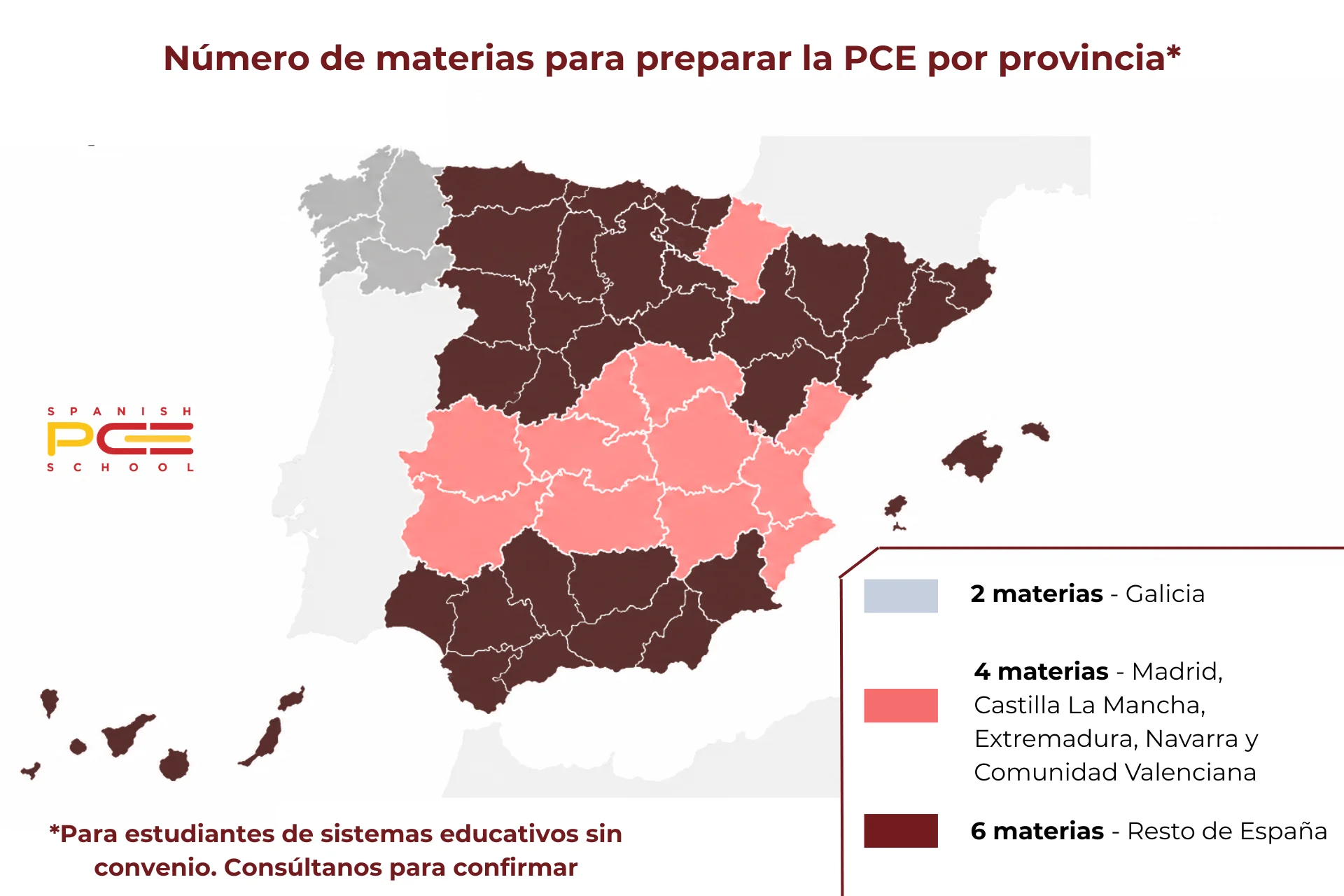
The PCE is organized by subject. The course offerings may include subjects such as Mathematics, Physics, Chemistry, Biology, Spanish History, Language, Economics, Geography, Technical Drawing, or other subjects, depending on the specific call for applications and the official offerings from UNEDasiss. Students may take the PCE for a maximum of 6 subjects, with the minimum number determined by the host university. The choice of these subjects depends on the student’s home educational system and the admission requirements of the university where they wish to begin their studies.
How to Choose PCE Subjects?
Choosing subjects is one of the most important decisions. At PCE Spanish School, we always warn students about this: it is not always best to choose the subjects that seem easiest. The smartest choice is to choose the subjects that best fit:
- The university degree you want to study.
- The university’s weighting system.
- Your academic background.
- Your Spanish level.
- The time you have to prepare.
For example, if you want to study a Health Sciences degree, subjects such as Biology or Chemistry may be useful. If you want to study Engineering, you may need Mathematics or Physics. If your goal is a degree in Social Sciences, Economics, History, or Applied Mathematics may be more relevant.
Ask us and we will help you choose the best subject combination for your university access.
When Are the PCE Exams?
The PCE exams usually have two main exam sessions per year: an ordinary session in May/June and an extraordinary session in September. You can check the official exam calls and dates on the corresponding information page.
Important Advice on Dates
It is not advisable to wait until the last minute. In addition to preparing for the exams, you need to review documentation, accreditation, subjects, the destination university, and admission deadlines. . At PCE Spanish School, we recommend starting your preparation well in advance, especially if you also need to improve your academic Spanish
What Level of Spanish Do I Need to Prepare for the PCE Exams?
This is a very important point, and one in which we have extensive experience. The PCE exams are not only content exams. For many international students, they are also a linguistic challenge. Even if you know the subject in your own language, you need to understand exam questions, explain concepts, write answers, and study academic materials in Spanish. Therefore, if your Spanish level is still low, preparing for the PCE exams can be more difficult. Ideally, students should work on several areas at the same time:
- General Spanish.
- Academic Spanish.
- Subject-specific vocabulary.
- Understanding exam questions.
- Exam techniques.
- Clear and organized writing.
This is where a combined course can make a difference. It is not only about studying Mathematics, History, or Biology, but also about learning how to answer correctly in Spanish. The idea is to first reach an acceptable level of reading comprehension and then continue improving writing and oral communication.
What Level of Spanish Do Universities Require?
Many universities require a certified B2 level of Spanish. This means that, before starting the admission process or before enrolling, students may need to submit documentation proving their Spanish level. A common option is to prepare for an official Spanish certification such as SIELE or DELE, depending on the university’s requirements. There may also be other valid certificates, but this depends on each institution.
Regardless of whether the university requires a certificate, having at least a B2 level is usually a strong foundation for understanding university classes, communicating with professors and classmates, and making the most of the academic experience.
How to Prepare for the PCE Exams as an International Student
Preparing for the PCE exams requires planning. Studying hard is not enough: you need to study the right content and follow a clear strategy.
- Define what degree you want to study. The first step is to know which degree you want to pursue in Spain. Preparing for Medicine, Engineering, Business Administration, Psychology, Law, or Communication is not the same.
- Review the university requirements. Each university may have different criteria. UNEDasiss provides guidance about universities and reminds students that requirements may be updated, so it is always advisable to check the official information of your target university.
- Choose your subjects wisely. The choice of subjects can directly affect your admission score. That is why it is important to choose subjects that carry weight for your degree and that you can prepare with confidence.
- Assess your Spanish level. If you need to improve your Spanish, start as soon as possible. A good level of comprehension and expression will help you study better and answer the exam with more confidence.
- Follow a study plan. Organize a realistic calendar with theory, practice, mock exams, and error review. Preparation should be adapted to your goals and available time.
Spanish Course and PCE Preparation at PCE Spanish School
At PCE Spanish School, we help international students who want to study in Spain and need to prepare for the Specific Competency Tests. Our course combines Spanish language training with the academic preparation needed to take these exams. This way, students not only learn subject content, but also improve their ability to understand, study, and answer in Spanish.
We recommend that you review our Spanish + University Access courses to see the options we have prepared.
What Do We Cover in the Course?
In our course, we can help you:
- Improve your Spanish level.
- Understand academic texts and statements.
- Prepare PCE subjects according to your university goal.
- Organize a study plan.
- Practice exercises and exam models.
- Resolve doubts about the Spanish university access process.
Who Is This Course For?
This course is designed for international students who want to access a Spanish university and need comprehensive preparation: language, subject content, guidance, and practice.
Common Mistakes When Preparing for the PCE Exams
Many students begin preparing for the PCE exams without a clear strategy. These are some common mistakes:
- Choosing subjects without reviewing weightings. Not all subjects have the same value for all degrees. Choosing poorly can mean studying a lot without improving your admission score as much as expected.
- Starting too late. The PCE exams require time. If you also need to improve your Spanish, it is advisable to start several months in advance.
- Studying only theory. Exams require practice. It is important to do exercises, mock exams, and time-management practice.
- Not working on academic Spanish. You may know a subject, but if you do not understand exam questions well or do not know how to express your answer in Spanish, your performance can drop.
Conclusion: PCE Exams Are a Gateway to Spanish Universities
The Specific Competency Tests are a key part of the process for many international students who want to study in Spain.
Preparing for them properly involves much more than memorizing content. You need to choose your subjects correctly, understand university requirements, organize a study plan, and, in many cases, improve your academic Spanish.
At PCE Spanish School, we can help you prepare for this process with a course designed for international students who want to learn Spanish and access Spanish universities.
Frequently Asked Questions About PCE Exams
- What does PCE stand for? PCE stands for Specific Competency Tests. These are subject-specific exams that international students can take to access Spanish universities or improve their admission score.
- Are PCE exams mandatory for all international students? Not always. It depends on your education system of origin, the Spanish university you want to access, and the degree you want to study. That is why it is important to review each case individually.
- Who organizes the PCE exams? The PCE exams are part of the UNEDasiss system, managed by UNED, which offers accreditation and examination services for international students who want to study in Spain.
- How many PCE subjects can I take? According to the official UNEDasiss offer, students can take PCE exams in up to 6 subjects. The usual number depends on the university requirements and the student’s education system of origin.
- When are the PCE exams? There are usually two main exam sessions: one in May/June and another in September.
- What subjects should I choose for the PCE exams? It depends on the degree you want to study, the destination university, the subject weightings, and your academic profile. It is recommended to receive guidance before choosing.
- Do I need to know Spanish to take the PCE exams? Yes. Spanish is especially important for understanding exam questions, studying academic materials, and writing answers clearly.
- Does PCE Spanish School prepare students for these exams? Yes. At PCE Spanish School, we offer training for international students who want to improve their Spanish and prepare for the PCE exams to access university in Spain.