¿Eres estudiante?
Sí.

Learn how to form questions in Spanish and practise the main interrogative words with interactive exercises. Complete the activities, check your answers and learn how to qué, quién, dónde, cuándo, cómo, cuánto and por qué.
¿_____ vives?
In Spanish we can ask questions using the intonation or different interrogative words.
Spanish questions are written between two question marks: an opening question mark at the beginning and a closing question mark at the end.
¿Cómo te llamas?
¿Dónde vives?
¿Hablas español?
Unlike in many other languages, Spanish uses an opening question mark ¿ and a closing question mark ?.
Some questions can be answered simply with sí or no. These questions do not necessarily require an interrogative word.
¿Eres estudiante?
Sí.
¿Vives en Madrid?
No.
¿Tienes hermanos?
Sí, tengo dos hermanos.
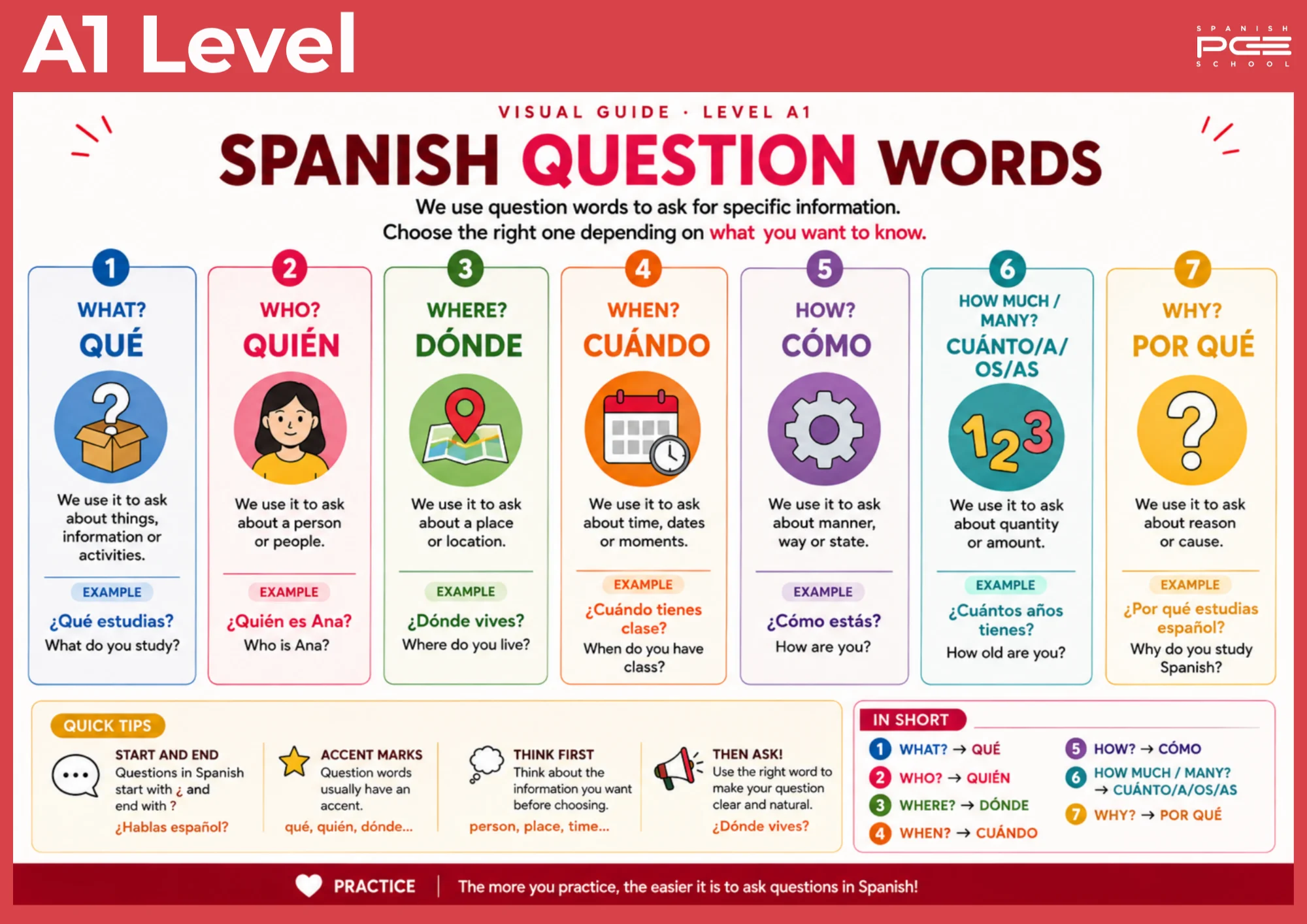
Each question word is used to ask about a different type of information: people, places, times, quantities, reasons, or things.
| Interrogative word | Used to ask about… | Example |
|---|---|---|
| qué | things or information | ¿Qué estudias? |
| quién / quiénes | people | ¿Quién es Ana? |
| dónde | places | ¿Dónde vives? |
| cuándo | times or dates | ¿Cuándo tienes clase? |
| cómo | manner, state, or personal information | ¿Cómo estás? |
| cuánto/a/os/as | quantities | ¿Cuántos años tienes? |
| por qué | causes or reasons | ¿Por qué estudias español? |
We use qué to ask about things, information or activities.
We use quién or quiénes to ask about people.
We use dónde to ask about a place.
We use cuándo to ask about a time or date.
We use cómo to ask about manner, state or certain types of personal information.
We use cuánto, cuánta, cuántos and cuántas to ask about quantities.
We use por qué to ask about a cause or reason.
Before asking the question, think about the information you want to obtain. The type of information will help you choose the correct interrogative word.
The answer contains a clue. Identify whether it refers to a place, quantity or reason, and then form the corresponding question. corresponding question.
Vivo en Madrid.
¿Dónde vives?
Tengo 21 años.
¿Cuántos años tienes?
Estudio español porque quiero vivir en España.
¿Por qué estudias español?
Review the main Spanish Interrogative words in Spanish and learn when to use qué, quién, dónde, cuándo, cómo, cuánto and por qué. The guide includes simple examples to help you form questions correctly.
Download the PDF ↓ Free PDF · No registration requiredNow it's your turn. Complete the following exercises and choose the correct interrogative word for each question.

Time's up
Learning to ask questions is essential for having a conversation. Exercises help you understand the structure, but you also need to practise it in real-life situations.
At PCE Spanish School,, you can learn Spanish with specialized teachers and practice conversation, grammar, and vocabulary in live online classes.

Choose the correct question for this answer:
“Vivo en Madrid”.

Pay attention to question marks, written accents and the type of information you want to obtain.
Spanish questions take opening and closing symbols. In addition, question words are accented.
When qué When used as an interrogative word, it is written with an accent.
To ask about a quantity, we use cuánto, cuánta, cuántos or cuántas.
To ask about a cause or a reason, we use por qué, written as two words and with an accent.
Review the most common questions about how to ask questions correctly in Spanish.
The most important interrogative words for beginners are qué, quién, dónde, cuándo, cómo, cuánto and por qué.
Each one is used to ask for a different type of information. .
Yes. When used as interrogative words, forms such as qué, quién, dónde, cuándo, cómo, cuánto and por qué.
¿Qué estudias? ¿Dónde vives? ¿Cómo estás?
We use qué to ask about things, information, or activities. We use quién to ask about people.
¿Qué es esto? · ¿Quién es él?
We use cuánto, cuánta, cuántos or cuántasdepending on the gender and number of the noun.
¿Cuánto cuesta? · ¿Cuántos libros tienes?
We use por qué, separated and with an accent mark, to ask about a cause or a reason. We use Why, written together and without an accent mark, to answer or explain the reason.
¿Por qué estudias español?
Porque quiero vivir en España.
We use our own and third-party cookies to analyze navigation, improve our services, and ensure the proper functioning of the website. You can accept all cookies, reject them, or configure them. You can learn more at Cookie Policy.