
Spanish grammar · Level A2

A2 Imperfect Tense Exercises

Learn how to form and use the Spanish imperfect tense and practise with interactive A2-level exercises. Discover how to talk about habits, describe people and situations, and express actions that were in progress in the past.

Start the 15-question exercise Free · Instant result
Choose the correct option

Cuando era pequeño, _____ al fútbol todos los días.

jugaba jugué he jugado
Correct! De pequeño jugaba al fútbol todos los días.
A2 level Interactive exercises Free online practice
Key concept

What is the imperfect tense?

The imperfect tense is a past tense that we mainly use to talk about habits, descriptions and situations that were in progress.

A look at the past

We explain what things were like

With the imperfect, our focus is not on presenting a specific action as complete. We want to explain what a situation was like, what used to happen or what was happening.

This makes it particularly useful for looking back on stages of life, describing places and setting the scene for a story.

¿Cómo era? ¿Qué hacía habitualmente? ¿Qué estaba pasando?
Habit Cuando era pequeño, jugaba al fútbol todos los días. It was a repeated action during a period in the past.
Situation Mi abuela vivía en un pueblo. We describe a past situation.
Description La casa era grande y tenía un jardín. We explain what a place was like in the past.
Action in progress A las diez todavía dormíamos. The action was in progress at that moment.
Habits Descriptions Actions in progress Imperfect tense
Formation

How the imperfect tense is formed

The imperfect conjugation is quite regular. There are two main groups: -ar → -aba and -er / -ir → -ía.

-AR -ABA
-ER / -IR -ÍA
First conjugation

Verbs ending in -ar

We take as our example hablar. We remove -ar and add the endings in -aba.

Swipe sideways to view the table
Person Hablar
yo hablaba
hablabas
él / ella / usted hablaba
nosotros/as hablábamos
vosotros/as hablabais
ellos / ellas / ustedes hablaban

De pequeño hablaba mucho con mis abuelos.

Antes trabajábamos juntos.

Los niños jugaban en el parque.

Second and third conjugations

Verbs ending in -er and -ir

Verbs ending in -er and -ir share the same endings in the imperfect tense.

Swipe sideways to view the table
Person Comer Vivir
yo comía vivía
comías vivías
él / ella / usted comía vivía
nosotros/as comíamos vivíamos
vosotros/as comíais vivíais
ellos / ellas / ustedes comían vivían

Antes comía en casa todos los días.

Cuando éramos estudiantes, vivíamos en Madrid.

Mis abuelos salían a pasear.

Main uses

When do we use the imperfect tense?

The imperfect is more than a set of past-tense verb forms. We use it to express habits, descriptions, states and actions that were in progress.

Repetition

Habits and repeated actions

We use the imperfect to talk about things that we used to do regularly in the past.

Cuando era pequeño, jugaba al fútbol todos los días.

Antes iba al gimnasio cada mañana.

Los domingos comíamos con mis abuelos.

antes siempre todos los días de pequeño/a
Setting

Descriptions in the past

We describe the characteristics of a person, a place, an object or a situation in the past.

Mi abuelo era alto y tenía el pelo blanco.

Nuestra casa era pequeña, pero tenía un jardín enorme.

El pueblo estaba cerca del mar.

Hacía mucho frío y eran las once.

Personal situation

Physical, mental and emotional states

We describe how someone felt, what they thought, what they knew or what they wanted in a past context.

Estaba cansado.

No sabía la respuesta.

Quería irme a casa.

Pensaba que la tienda estaba abierta.

In progress

Actions that were in progress

We present an action that was in progress at a particular moment in the past.

A las diez dormía.

Ayer a esta hora trabajábamos.

Cuando llegaste, yo estudiaba.

Action in progress Yo estudiaba
Event cuando llegaste
Two perspectives on the past

Imperfect and preterite: an important difference

The imperfect helps us describe what a situation was like. The preterite allows us to say what happened.

Imperfect tense Cuando era pequeño, jugaba al fútbol todos los días. It expresses a habit during a period in the past.
Preterite tense Ayer jugué al fútbol. It presents a specific, completed action.
Imperfect tense La casa era muy grande. It describes the characteristics of the house in the past.
Preterite tense Mis padres compraron la casa en 2015. It describes an event that happened at a particular moment.
Imperfect: ¿Cómo era?
Preterite: ¿Qué pasó?
Comparison at a glance

Imperfect versus preterite

Swipe sideways to compare the tenses
Imperfect tense Preterite tense
¿Cómo era? ¿Qué pasó?
Habits Completed actions
Descriptions Events
Situations in progress Specific actions
De pequeño jugaba. Ayer jugué.
Actions in progress

Imperfect or estar + gerundio?

In some contexts, we can use either the imperfect or estar + gerundio to talk about an action that was in progress.

Imperfect tense

We present the action as background

The imperfect can show an action that was in progress and forms part of the background situation.

Action in progress Cuando llamaste, estudiaba.
Progressive construction

We emphasise the action in progress

Estar + gerundio makes it more explicit that the action was in progress at that moment.

Action in progress Cuando llamaste, estaba estudiando.
estaba estudiando
Another example

—¿Qué hacías cuando empezó a llover?

Caminaba por el parque.

Estaba caminando por el parque.

VISUAL GUIDE · LEVEL A2
Imperfect tense

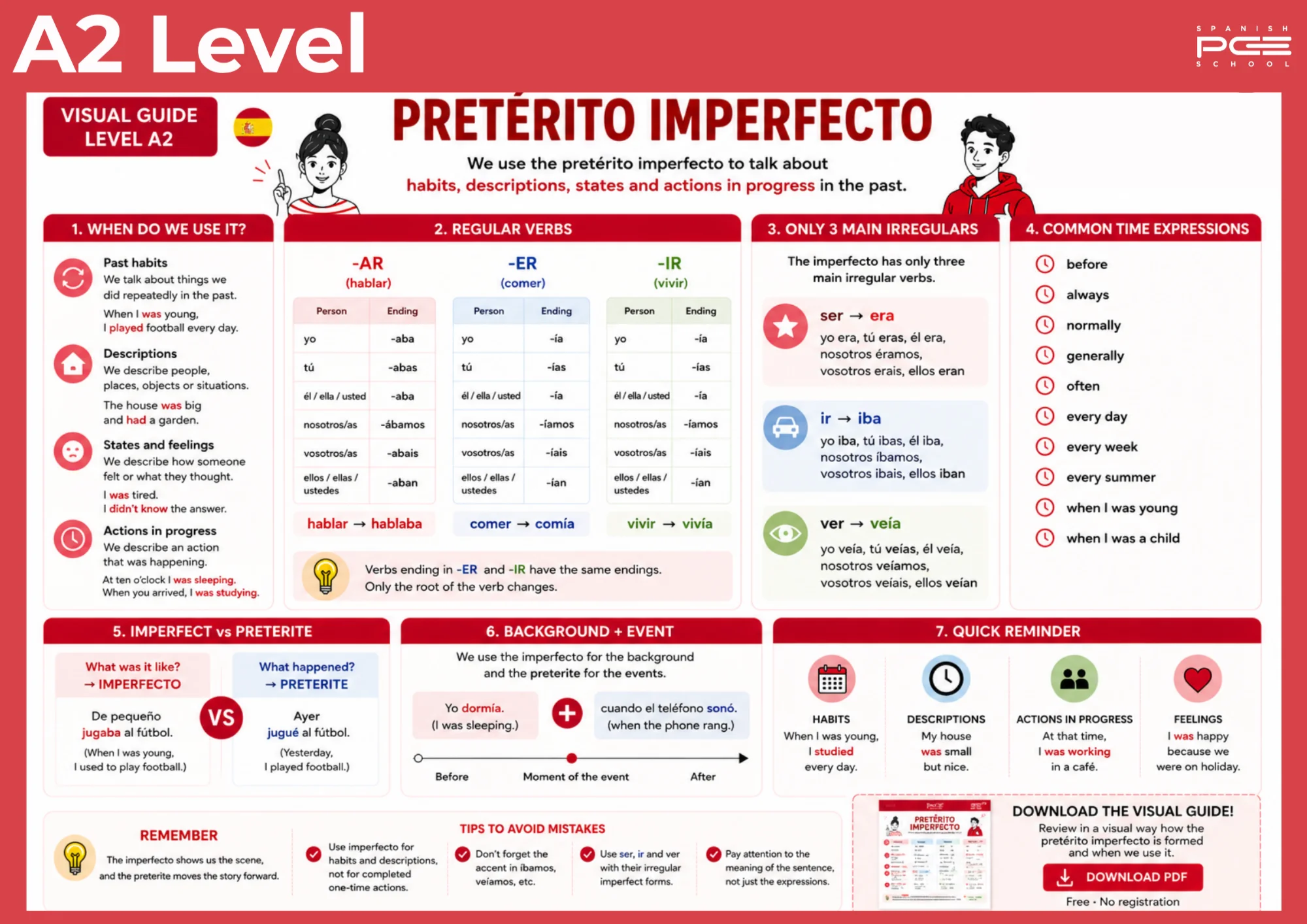
Review at a glance how we form and when we use the imperfect tense. Learn how to talk about habits, descriptions and situations in the past, practise the endings -aba and -ía and remember the main irregular verbs: ser, ir y ver.

Download the PDF ↓ Free PDF · No registration required
Practise what you have learnt

A2 Imperfect Tense Exercises

Now it’s your turn. Complete the following exercises using the imperfect tense. Pay attention to the endings -aba and -ía, the irregular verbs ser, ir and ver and the meaning of each sentence.

1 Conjugate the regular verbs
2 Practise the verbs ser, ir and ver
3 Choose the correct tense for the context
A2 "Pretérito Imperfecto" Exercise
Learn Spanish naturally
Do you know the past-tense forms but hesitate when you start speaking?

Understanding the rules is important, but using verb tenses naturally takes practice in real conversations and situations.

At PCE Spanish School you can learn Spanish with specialised teachers and work on grammar, vocabulary and conversation in live online classes.

  • Live online classes
  • Specialised teachers
  • Small groups
  • Real-life conversation practice
  • Grammar and vocabulary
  • Personalised corrections
Spanish class Past tenses and conversation
A2

Complete the sentence:
“Mi antigua casa _____ un jardín”.

tenía tuvo ha tenido tendrá
Correct! Mi antigua casa tenía un jardín.
Past description tenía
Avoid these common mistakes

Common mistakes with the imperfect tense

Review the most common mistakes with conjugation and the uses of the imperfect tense.

Jugaba ayer Jugaba todos los días

Cuando era pequeño, jugaba ayer al fútbol.
Cuando era pequeño, jugaba al fútbol todos los días.

The imperfect is often used to express habits, rather than a single, specific completed action.

Yo vivaba Yo vivía

Yo vivaba en Madrid.
Yo vivía en Madrid.

Verbs ending in -ir use the endings in -ía: vivir → vivía.

Nosotros ibamos Nosotros íbamos

Todos los veranos ibamos a la playa.
Todos los veranos íbamos a la playa.

The first-person plural form has a written accent: nosotros íbamos.

Fui muy tímido Era muy tímido

Cuando era niño, fui muy tímido.
Cuando era niño, era muy tímido.

To describe what a person was like during a period in the past, we normally use the imperfect tense.

Sonaba mientras dormí Sonó mientras dormía

El teléfono sonaba mientras dormí.
El teléfono sonó mientras dormía.

We use the imperfect for the situation that was in progress and the preterite for the specific event.

Background and event
Context Yo dormía.
Event El teléfono sonó.
Your questions answered

Frequently asked questions about the imperfect tense

Review the main rules for this past tense and how it differs from other forms.

What is the imperfect tense?

It is a past tense that we mainly use to talk about habits, descriptions, states and situations in progress.

Cuando era pequeño, vivía en Madrid.
How is the imperfect tense formed?

Verbs ending in -ar use endings in -aba, whereas verbs ending in -er and -ir use endings in -ía.

  • hablar → hablaba
  • comer → comía
  • vivir → vivía
Which verbs are irregular in the imperfect tense?

The three main irregular verbs are ser, ir and ver.

  • ser → era
  • ir → iba
  • ver → veía
What is the difference between “jugaba” and “jugué”?

Jugaba can express a habit, a description or an action that was in progress. Jugué presents a specific action as complete.

De pequeño jugaba al fútbol.
Ayer jugué al fútbol.
Can we use the imperfect and the preterite together?

Yes. It is very common to use the imperfect to describe a situation that was in progress and the preterite to introduce a specific event.

Dormía cuando el teléfono sonó.