Spanish grammar · Level A2

Future and plans exercises A2

Learn to talk about plans, intentions, and future actions in Spanish and practice with interactive A2-level exercises. Discover the most common ways to express the future and learn when to use going to + infinitive, the present and the simple future .

Start the 15-question exercise Free · Instant result
Choose the correct option

This afternoon I _____ español.

I am going to study I am going to the studio I am going to study
Correct! This afternoon I am going to study Spanish.
A2 level Interactive exercises Free online practice
Introduction

How do we talk about the future in Spanish?

In Spanish we can talk about the future in different ways. We do not always need to use the simple future.

In fact, in many conversations we use other structures to talk about our plans or things we know are going to happen.

To go + infinitive

We use it mainly to express plans, intentions and decisions that we have already taken.

I am going to study this afternoon.

Present Indicative

It can refer to the future when a clear time reference or we are talking about an organized plan.

Tomorrow I have class.

Simple future

It allows us to talk about future actions and also express predictions or possibilities.

Someday I will live in another country.
Plans and intentions

To go + infinitive

One of the most frequent ways to talk about the future in Spanish is to go + infinitive. We use this structure especially to express plans, intentions, or decisions that we have already made.

Conjugation of the verb to go a Infinitive
Swipe sideways to see the whole table
Conjugation of "ir a + infinitive"
Person To go + to Example
yo I am going to I am going to study
you are going to you are going to travel
él / ella / usted is going to He is going to work
nosotros/as let's go We are going out
vosotros/as Are you going to Are you going to eat
ellos / ellas / ustedes are going to They are going to visit

Examples

This afternoon I am going to study español.
El sábado let's visit to my grandparents.
Laura is going to fetch a new job.
What are you going to do this weekend?
Organized plans

The present can also speak of the future

In Spanish we frequently use the present indicative to talk about future events when there is a clear time reference.

Tomorrow work.

The verb is in the present tense, but “tomorrow” places the action in the future.
On Friday tenemos an exam.
This summer I am traveling to Mexico.
The train sale At eight.

It is especially common to talk about:

Organized plans

Tomorrow como with Marta.

Appointments and commitments

On Tuesday I have a meeting.

Schedules

The airplane sale a las diez.

Well-defined plans

This weekend vamos to Valencia.

Time markers

Time expressions to talk about the future

These expressions frequently appear when we talk about plans and future events and they help us clearly situate when an action will occur.

Near future

  • hoy
  • this afternoon
  • tonight
  • Later
  • Ready

Upcoming days

  • tomorrow
  • day after tomorrow
  • in two days
  • this weekend
  • next Monday

Later

  • next week
  • next month
  • next year
  • someday
  • in the future
This afternoon I am going to study.
Next week We have an exam.
Next year I will travel more.
In two days Let's start the course.
This afternoon Next week Someday
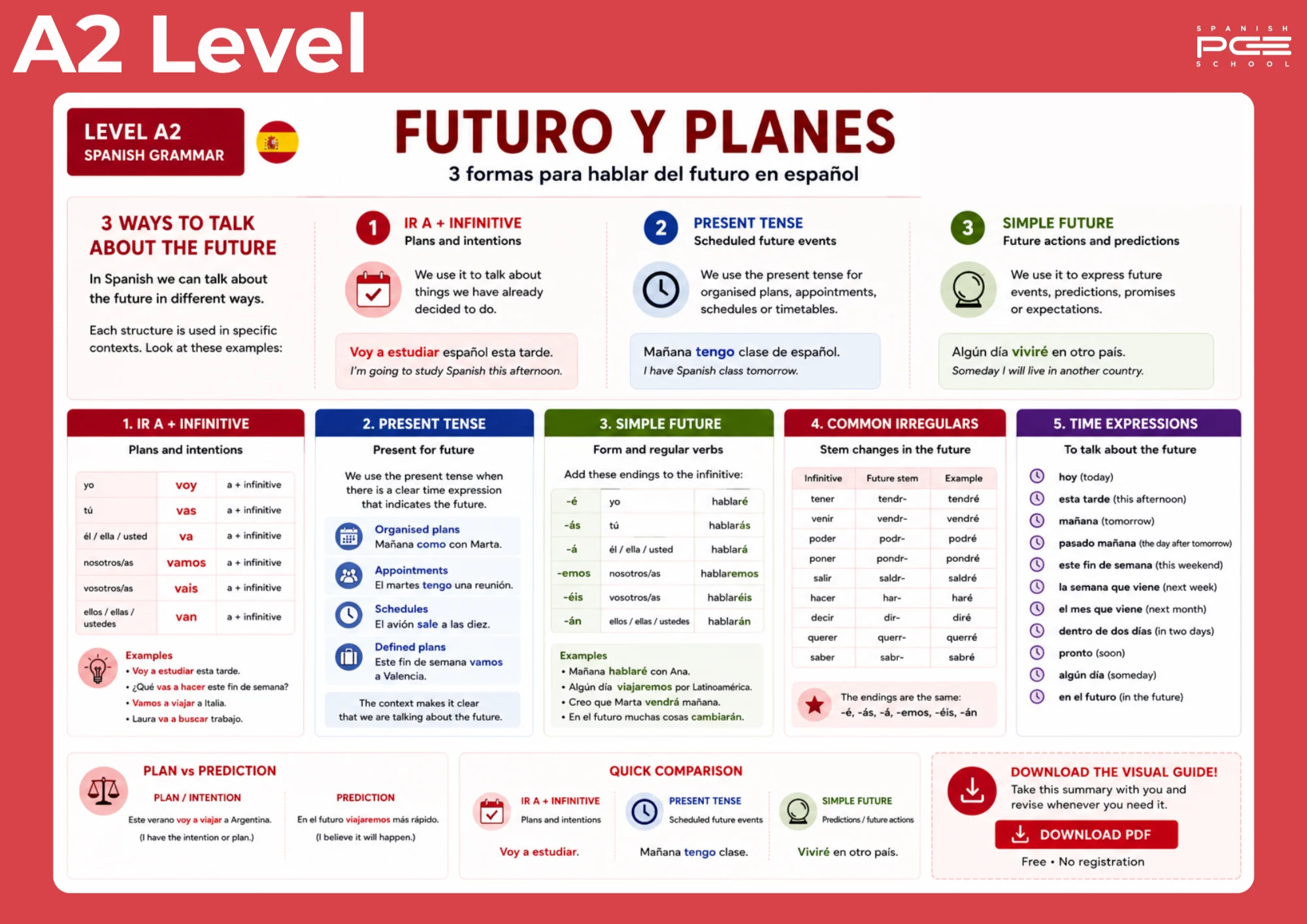
VISUAL GUIDE · LEVEL A2
Future and Plans

Visually review the main forms of talking about the future in Spanish. Learn how to use to go + infinitive, the present with future value and the simple future to express plans, intentions, future events and predictions.

Download the PDF ↓ Free PDF · No registration required
Practise what you have learnt

Future and plans exercises A2

Now is the time to practice. In the following 15 exercises you will work on the main ways of talking about the future that we have seen on this page.

To go + infinitive Plans, decisions, and intentions.
Present Indicative Present tense with future value.
Simple future Regular forms, irregular forms, and real-life situations.
A2 "Futuros y planes" Exercise
Learn Spanish naturally
Do you want to start talking about the future without overthinking every sentence?

Knowing the structures is important, but the real goal is to be able to use them when you speak.

You may already know that I am going to study, I work tomorrow and I will study they talk about the future, but that you still have to think too much before choosing a structure. That is completely normal when you are learning Spanish.

At PCE Spanish School We work on grammar within real-life situations so you can go from understanding a structure to using it naturally.


  • Talk about your personal plans
  • Explain what you are going to do
  • Conversation about the future
  • Grammar in Real-Life Situations
  • Live online classes
  • Specialised teachers
Learn Spanish with us
Spanish class Plans and conversation

What are you going to do this weekend?

I am going to visit Toledo and I am going to eat with some friends.

Great! And what's the weather like you think it will be?

I think hará Good weather.

Grammar used in a real conversation
Attention to these errors

Common mistakes when talking about the future

Review these common mistakes to correctly build your sentences and choose the appropriate future structure.

Conjugate the verb after “ir a”

I'm going I study español.

I'm going estudiar español.

After to go, we always use the infinitive. The second verb is not conjugated.

Forget the preposition “a”

I'm going estudiar this afternoon.

I'm going Time to study this afternoon.

The preposition a is mandatory within this structure.

ir + a + infinitive

To think that we always need the simple future tense

Tomorrow work.

Tonight I am going out.

In Spanish we use the... present indicative and to go + infinitive to talk about the future. We don't always need forms like I will study, I will travel or I will eat.

Change the endings according to the verb

hablar → I will speak

comer → I will eat

vivir → I will live

In the simple future, verbs ending in -ar, -er and -ir use the same endings.

Incorrectly form the simple future

I will speak

I will speak

The ending is added directly to the full infinitive. We do not add a second verb ending.

hablar + = I will speak
Your questions answered

Frequently asked questions about the future in Spanish

Review the main ways to express plans, intentions, and future events.

What is the most common way to talk about plans?

To go + infinitive it is one of the most common structures for expressing plans, decisions, and intentions.

I am going to study this afternoon.
Can I use the present tense to talk about the future?

Yes. It is very common to use the present indicative when there is a clear temporal reference or when we are talking about an organized plan.

Tomorrow I have class.
When do we use the simple future?

It is used to talk about future events and is especially useful for expressing predictions, promises or situations that we present as future.

Someday I will travel to Japan.
How is the simple future formed?

In regular verbs we add directly to the full infinitive the same endings for the verbs in -ar, -er and -ir.

  • -you will
  • -emos
  • -éis
  • -án
hablar + = I will speak
I will speak, you will eat and We will live.
Do all verbs form the future tense in the same way?

The endings are the same, but some verbs use a irregular root.

  • to have → I will have
  • can → will be able
  • do → will do
  • hacer → haré
Is “voy a estudiar” the same as “estudiaré”?

Both forms can talk about the future, but they do not always convey the exact same perspective.

I am going to study tends to present an intention or a plan, whereas I will study presents the action as future. Context often determines which one is more natural.

This afternoon I am going to study.
Someday I will study Japanese.