The verb haber
We conjugate haber according to the person performing the action.
| Person | Haber |
|---|---|
| yo | he |
| tú | has |
| él / ella / usted | ha |
| nosotros/as | hemos |
| vosotros/as | habéis |
| ellos / ellas / ustedes | han |
Learn how to form and use the Spanish present perfect and practise with interactive A2 exercises. Work with regular and irregular past participles, learn when we use this tense and check your answers instantly.
Esta semana nosotros _____ tres clases.
The present perfect is a tense we use to talk about past actions that have a connection with the present.
The action happened before the moment of speaking, but we place it within a period that we still consider current.
This period can be hoy, esta semana or even our entire experience hasta ahora.
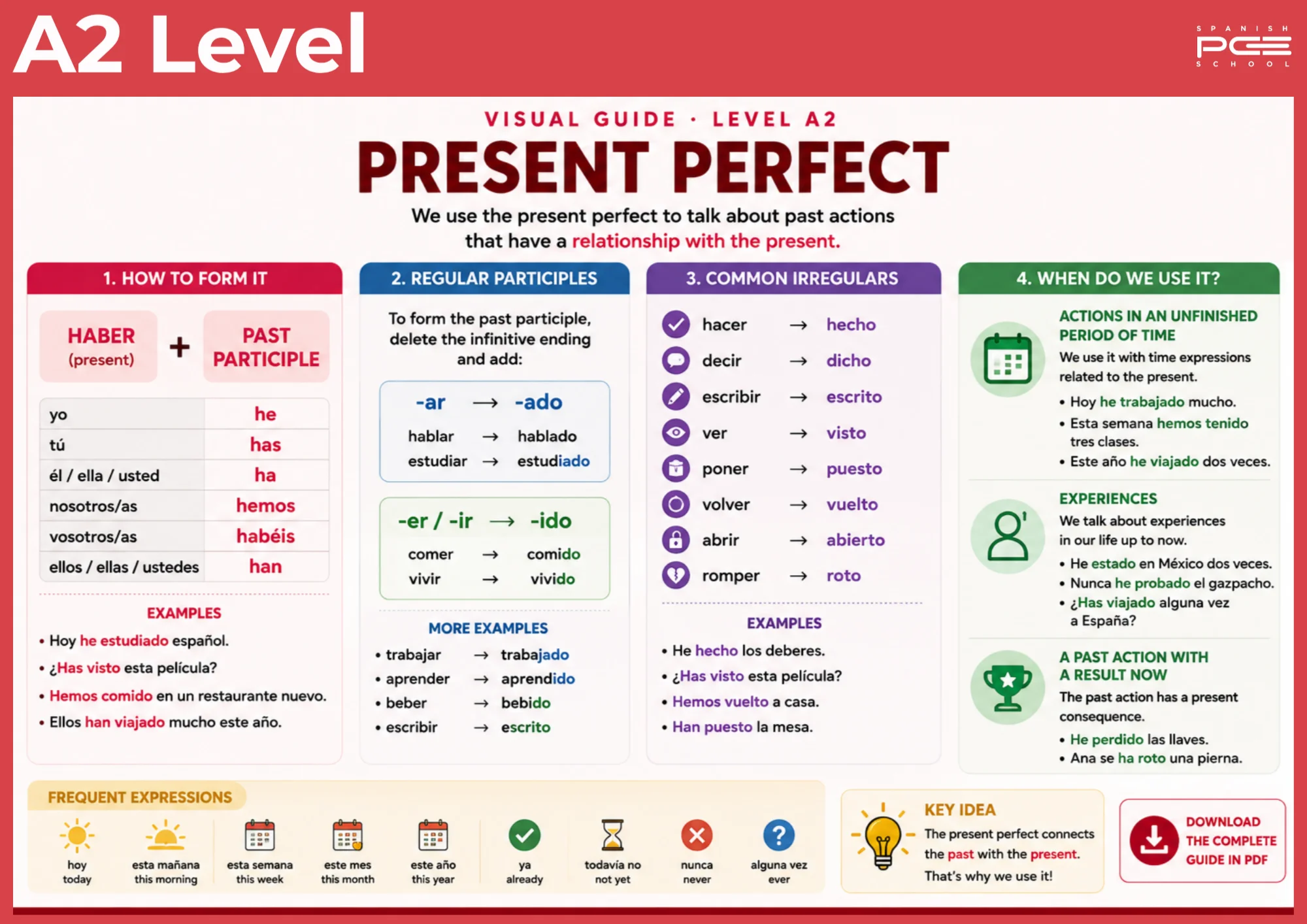
To form the present perfect, we need the verb haber in the present tense and the past participle of the main verb.
We conjugate haber according to the person performing the action.
| Person | Haber |
|---|---|
| yo | he |
| tú | has |
| él / ella / usted | ha |
| nosotros/as | hemos |
| vosotros/as | habéis |
| ellos / ellas / ustedes | han |
We remove the infinitive ending and add -ado or -ido.
| Infinitive | Ending | Past participle |
|---|---|---|
| hablar | -ar → -ado | hablado |
| comer | -er → -ido | comido |
| vivir | -ir → -ido | vivido |
Some common verbs do not form the past participle according to the rules for -adoand-ido. This is why we need to learn their irregular forms.
| Infinitive | Irregular past participle |
|---|---|
| hacer | hecho |
| decir | dicho |
| escribir | escrito |
| ver | visto |
| poner | puesto |
| volver | vuelto |
| abrir | abierto |
| romper | roto |
We use this tense to connect a past action with a current period, an experience or a present consequence.
We talk about actions that happened within a period that we still consider current.
Hoy he trabajado mucho.
Esta semana hemos estudiado los pasados.
Este año he viajado dos veces a España.
We express experiences that we have had —or have not had— at some point in our lives up to the present.
He estado en México dos veces.
Nunca he probado el gazpacho.
¿Has viajado alguna vez a España?
The action happened earlier, but its result remains relevant at the present moment.
Note: the use of the present perfect and the preterite can vary by region. These uses are particularly common in Spanish as spoken in Spain.
These expressions frequently appear with the present perfect and help us establish its connection with the present.
They place the action within a period that we still consider unfinished.
They indicate whether an experience or action has occurred up to the present moment.
Esta semana hemos tenido mucho trabajo.
Review visually how the present perfect is formed and when it is used. Learn the structure haber + past participle, the most common regular and irregular past participles, and the expressions that often accompany this tense.
Download PDF ↓ Free PDF · No registration requiredNow it is your turn. Complete the following exercises using the present perfectcorrectly. Pay attention to the form of haber, the past participle and irregular past participles.

Time's up
Learning the rules is only one part of the process. To use past tenses naturally, you need to practise them in conversations and real-life situations.
At PCE Spanish School you can learn Spanish with specialist teachers and work on grammar, vocabulary and conversation in live online classes.
Complete the sentence:
“Marta ya _____ los deberes”.
These are some of the most common mistakes when forming the present perfect. Look at the correction and remember the rule in each case.
After the verb haber we need a past participle, not an infinitive: comer → comido.
The present perfect is formed with the auxiliary verb haber, not with the verb ser.
The verb hacer has an irregular past participle that we need to memorise: hacer → hecho.
When it is used with haber, the past participle does not change according to gender or number. We always say he comido or hemos comido.
Review the most common questions about how this tense is formed and used.
It is formed using the present tense of the verb haber followed by the past participle of the main verb.
It is mainly used to talk about experiences and past actions connected with the present or situated within a period of time that we still consider current.
Some of the most common irregular past participles are hecho, dicho, visto, escrito, puesto, vuelto, abierto and roto.
No. When it forms the present perfect with haber, the past participle remains unchanged and does not agree with the person performing the action.
Both forms refer to the past, but they are not used in exactly the same way. In general, he comido connects the action with the present or with a period that we consider current.
By contrast, comí usually places the action in a past period that we consider finished. This distinction can vary by region and is studied in more detail when comparing past tenses.
Utilizamos cookies propias y de terceros para analizar la navegación, mejorar nuestros servicios y garantizar el correcto funcionamiento de la web. Puede aceptar todas las cookies, rechazarlas o configurarlas. Puedes conocer más en Política de cookies.