I have bought el libro. I have read el libro this afternoon.

Learn how to use the direct and indirect object pronouns in Spanish and practice with interactive A2-level exercises. Discover when to use him, her, it, them, you, to him, to her, to them, where to place the pronouns and how to combine them to avoid repetitions and speak more naturally.
I have bought the book. _____ I have been reading this afternoon.
When we speak, we often do not want to continually repeat the name of a person or a thing. Object pronouns allow us to avoid those repetitions.
I have bought el libro. I have read el libro this afternoon.
I have bought el libro. Lo I have been reading this afternoon.
They replace the person or thing that receives the action directly of the verb.
They usually replace the person who receives or benefits from the action.
The direct object (DO) It is the person or thing that directly receives the action of the verb. We can locate it by means of some guiding questions.
Marta buys the bread.
What does Marta buy?
The bread
Marta it Purchase.
I see To Laura every day.
Who do I see?
To Laura
La I see everyday.
We use these pronouns to substitute for the person or thing that directly receives the action. In the third person, we must pay attention to the gender and number.
| Person | Pronoun |
|---|---|
| yo | I |
| tú | you |
| he / you | it |
| she / you | la |
| nosotros/as | we |
| vosotros/as | bones |
| they / you | los |
| they / you | las |
The pronoun must agree with the person or thing that replaces.
I buy el libro.
Lo I buy.
I buy the magazine.
La I buy.
I buy the books.
Los I buy.
I buy the magazines.
Las I buy.
The indirect object (IO) indicates normally the person who receives or benefits from the action.
Marta gives a gift to Carlos .
What does Marta give?
A gift
Direct objectTo whom is he giving the gift?
To Carlos
Indirect objectMarta gives a gift to Carlos.
→Marta the Give a gift.
I am writing a message to my parents.
The I am writing a message.
These pronouns normally replace the person who receives or benefits from the action.
| Person | Pronoun |
|---|---|
| yo | I |
| tú | you |
| él / ella / usted | the |
| nosotros/as | we |
| vosotros/as | bones |
| ellos / ellas / ustedes | the |
In the third person we do not distinguish gender, but we must distinguish between singular and plural.
I give the book to Carlos.
The I give the book.
I give the book to Marta.
The I give the book.
I give the book to Carlos and Marta.
The I give the book.
So much to Carlos como to Marta are replaced by the.
A person uses the. Several people use the.
A single sentence can contain both a direct object and an indirect object. To choose the correct pronoun, we must understand What function does each element perform.
Ana buys a gift to his brother .
What does Ana buy?
A gift
Ana it Purchase.
“Lo” replaces “el regalo”.Whom is she buying the gift for?
To his brother
Ana the Buy a gift.
“Le” replaces “his brother”.| Characteristic | Direct object | Indirect object |
|---|---|---|
| Guiding question | What? / To whom? | To whom? / For whom? |
| Function | Receives the action directly. | Specify the recipient or addressee. |
| Third person | him, her, it, them | the |
| Example | Ana it Purchase. | Ana the Buy a gift. |
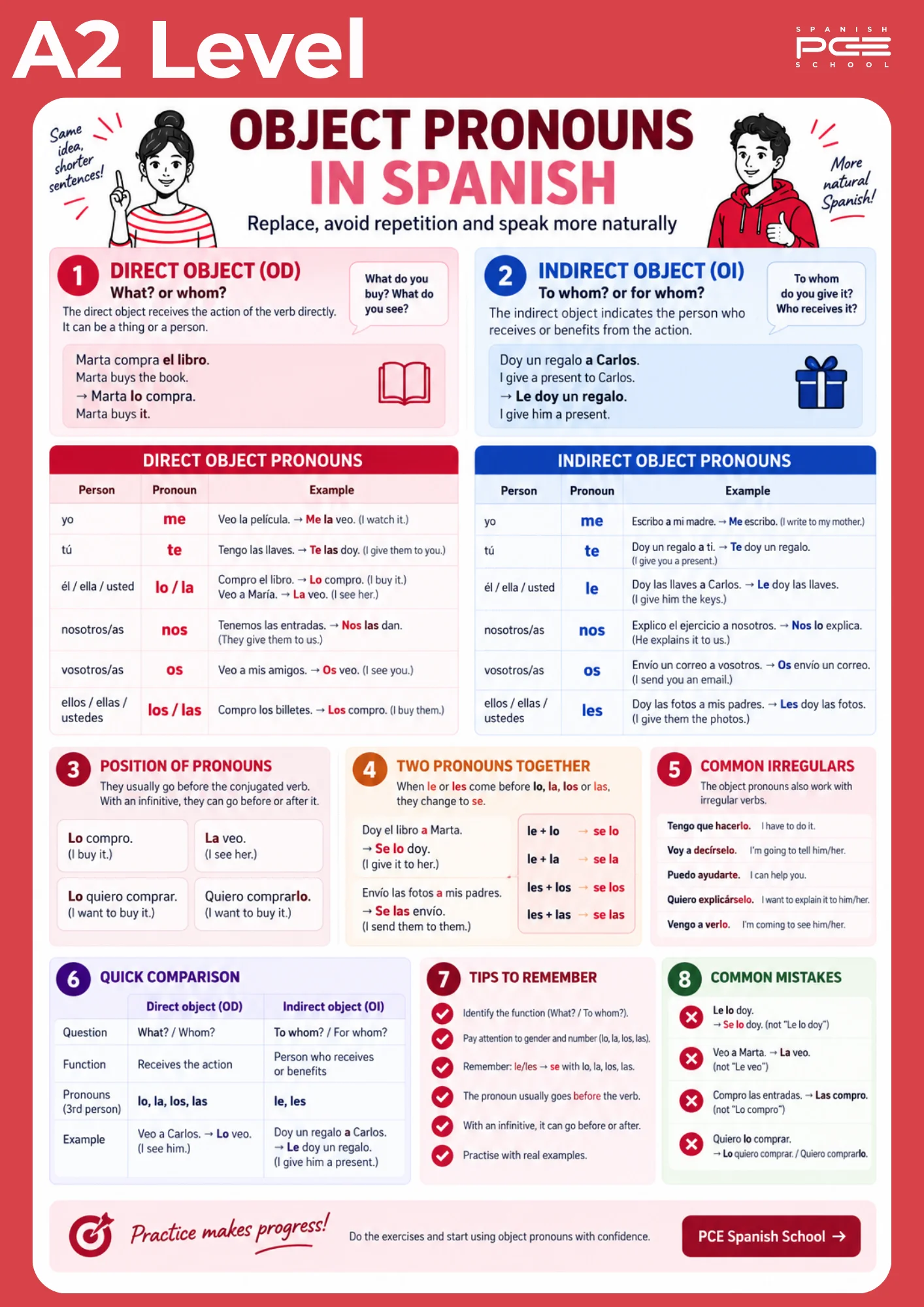
Review visually how to use the direct and indirect object pronouns.Learn when to use him, her, it, them, you, to him, to her, to them,where to place the pronouns and how to combine them correctly in structures like I take it to you, I take it for you, he takes it for himself or give them to them.
Download the PDF ↓ Free PDF · No registration requiredNow is the time to practice. In the following 15 exercises you will have to identify and correctly use direct and indirect object pronouns.
Read the full sentence first and identify what element are you replacing before choosing the answer.

Time's up
It is very common. You can perfectly understand that el libro becomes it and to Marta en the, but during a conversation there is no time to analyze every sentence.
To speak naturally, you need these structures to appear more and more automatically.
At PCE Spanish School We work on grammar within communicative situations so that you not only learn the rules, but can use them when you actually speak Spanish.
Learn Spanish with us
Have you bought el libro?
Yes, it I have bought.
Have you given the book to Marta?
Yes, give it to him I have given.
Review these common mistakes to choose the correct pronoun and place it correctly within the sentence.
I bought the book and then I read el libro.
I bought the book and then it I have read.
The first sentence is possible, but if we already know which book we are talking about, it is more natural to use it.
I see Marta.
→ La I see.
I give a book to Marta.
→ The I give a book.
In the first sentence, Marta directly receives the action of seeing. In the second, she is the recipient of the book.
I'm buying the tickets. Lo I buy.
I'm buying the tickets. Las I buy.
The direct object pronoun must agree in gender and number with the element it replaces.
Read it Doy.
I know it Doy.
When the or the appear in front of him, her, it, them or las, transform into if.
Lo I want to buy.
I want to buyit.
I want I will buy it.
With a conjugated verb followed by an infinitive, we can place the pronoun before the conjugated verb or attached to the infinitive, but never between the two verbs.
Review the differences, forms, and position of direct and indirect object pronouns.
The direct object receives directly the action of the verb, while the indirect object usually indicates the addressee or recipient of that action.
We use them mainly as pronouns of third-person direct object.They agree in gender and number with the element they replace.
We use them as pronouns of third-person indirect object. The corresponds to the singular and the to plural.
Why the and the they become if when they appear in front of him, her, it, them or las.
With a conjugated verb, it normally goes before: I'll buy it. With an infinitive, it can be attached at the end: I want to buy it.
In structures like to go + infinitive,Both positions are possible.
No. A person acting as a direct object can take the a personal. Therefore, we must not automatically identify plus one person with an indirect object.
We use our own and third-party cookies to analyze navigation, improve our services, and ensure the proper functioning of the website. You can accept all cookies, reject them, or configure them. You can learn more at Cookie Policy.