
Spanish grammar · Level A2

A2 Preterite Tense Exercises

Learn how to form and use the Spanish preterite tense and practise with interactive A2-level exercises. Work on regular and irregular verbs, learn to talk about completed actions in the past and check your answers instantly.

Start the 15-question exercise Free · Instant result
Choose the correct option

Ayer nosotros _____ al cine.

fuimos hemos ido vamos
Correct! Ayer nosotros fuimos al cine.
A2 level Interactive exercises Free online practice
Key concept

What is the Spanish preterite tense?

The Spanish preterite tense is a tense that we use to talk about actions completed in the past.

A finished time in the past

The action started and finished before the present

We use the preterite tense when we present an action as completed at a time before the present.

We normally place the action in a finished time period, such as ayer, el sábado, la semana pasada or el año pasado.

Key question ¿Qué pasó?
Ayer
Ayer trabajé hasta las seis. Yesterday is already over.
El sábado
El sábado fuimos al cine. The action took place on a day in the past that is now over.
El año pasado
Marta vivió en Madrid. The experience took place in a year that has already ended.
Past action Finished time period Preterite tense
Formation

How is the preterite tense formed?

The formation depends on whether the infinitive ends in -ar, -er or -ir. We separate the verb stem and add the ending for each person.

Verb stem Preterite ending Preterite tense
First conjugation

Verbs ending in -ar

We use the verb hablar. We remove -ar and add the preterite endings.

Swipe sideways to view the table
Person Hablar
yo hablé
hablaste
él / ella / usted habló
nosotros/as hablamos
vosotros/as hablasteis
ellos / ellas / ustedes hablaron

Ayer hablé con María.

Mis padres hablaron con el profesor.

Second and third conjugations

Verbs ending in -er and -ir

Regular verbs ending in -er and -ir use the same endings in the preterite tense.

Swipe sideways to view the table
Person Comer Vivir
yo comí viví
comiste viviste
él / ella / usted com viv
nosotros/as comimos vivimos
vosotros/as comisteis vivisteis
ellos / ellas / ustedes comieron vivieron

Ayer comimos en un restaurante.

Ana vivió tres años en México.

Mis amigos salieron a las diez.

Yo aprendí mucho durante el curso.

Special forms

Irregular verbs in the preterite tense

Some very common verbs change their stem in the preterite tense and use a special set of endings.

Stem changes

Common A2 irregular verbs

Swipe sideways to view the table
Infinitive Stem Example
tener tuv- tuve
estar estuv- estuve
poder pud- pude
poner pus- puse
saber sup- supe
venir vin- vine
querer quis- quise
Common endings

One set for all these verbs

-e -iste -o -imos -isteis -ieron
Example: tener
tuve tuviste tuvo tuvimos tuvisteis tuvieron

Añadimos las terminaciones directamente a la raíz: tuv- + -e = tuve.

Tener

Ayer tuve mucho trabajo.

Poder

No pudimos entrar.

Venir

Marta vino a mi casa.

Estar

Mis padres estuvieron en Sevilla.

Two verbs, one conjugation

Ser and ir: fui, fuiste, fue...

The verbs ser and ir have exactly the same forms in the preterite tense. The context tells us which verb we are using.

Ser
Ir
Complete conjugation

Preterite tense of ser and ir

Swipe sideways to view the table
Person Ser / Ir
yo fui
fuiste
él / ella / usted fue
nosotros/as fuimos
vosotros/as fuisteis
ellos / ellas / ustedes fueron
The key is in the context

How can we tell whether it means ser or ir?

We look at the words around the verb and the overall meaning of the sentence.

Verb ir Ayer fui al médico. It expresses movement towards a place.
Verb ser La película fue muy interesante. It expresses a characteristic or assessment.
Key irregular verbs

Hacer, decir and traer

These three verbs have irregular forms that are very common. Pay particular attention to hizo, dijeron and trajeron.

Hacer Irregular stem: hic- / hiz-
  • yo hice
  • hiciste
  • él / ella / usted hizo
  • nosotros/as hicimos
  • vosotros/as hicisteis
  • ellos / ellas / ustedes hicieron

Ayer hice los deberes.

Decir Irregular stem: dij-
  • yo dije
  • dijiste
  • él / ella / usted dijo
  • nosotros/as dijimos
  • vosotros/as dijisteis
  • ellos / ellas / ustedes dijeron

Laura me dijo la verdad.

Traer Irregular stem: traj-
  • yo traje
  • trajiste
  • él / ella / usted trajo
  • nosotros/as trajimos
  • vosotros/as trajisteis
  • ellos / ellas / ustedes trajeron

Mis amigos trajeron comida.

Third-person singular of hacer
Él hico
Él hizo

In the third-person singular, the letter c changes to z: hacer → hizo.

Verbs with stems ending in j
Ellos dijieron
Ellos dijeron

With stems ending in -j we use -eron, not -ieron.

Main uses

When do we use the preterite tense?

We use this tense for completed actions and events and to tell what happened in the past.

Completed action

Actions that started and finished

We present a past action as completely finished.

Ayer estudié tres horas.

El sábado compramos un coche.

María llamó esta mañana.

Finished time period

Actions set in a completed past period

It is particularly common when we mention a period that has already ended.

Ayer fui al médico.

La semana pasada tuvimos un examen.

El año pasado viajé a Italia.

Narration

Sequence of events

We use several preterite forms to describe actions that happened one after another.

Ayer Ana llegó a casa, abrió la puerta y encendió la luz.

Story order
llegó abrió encendió
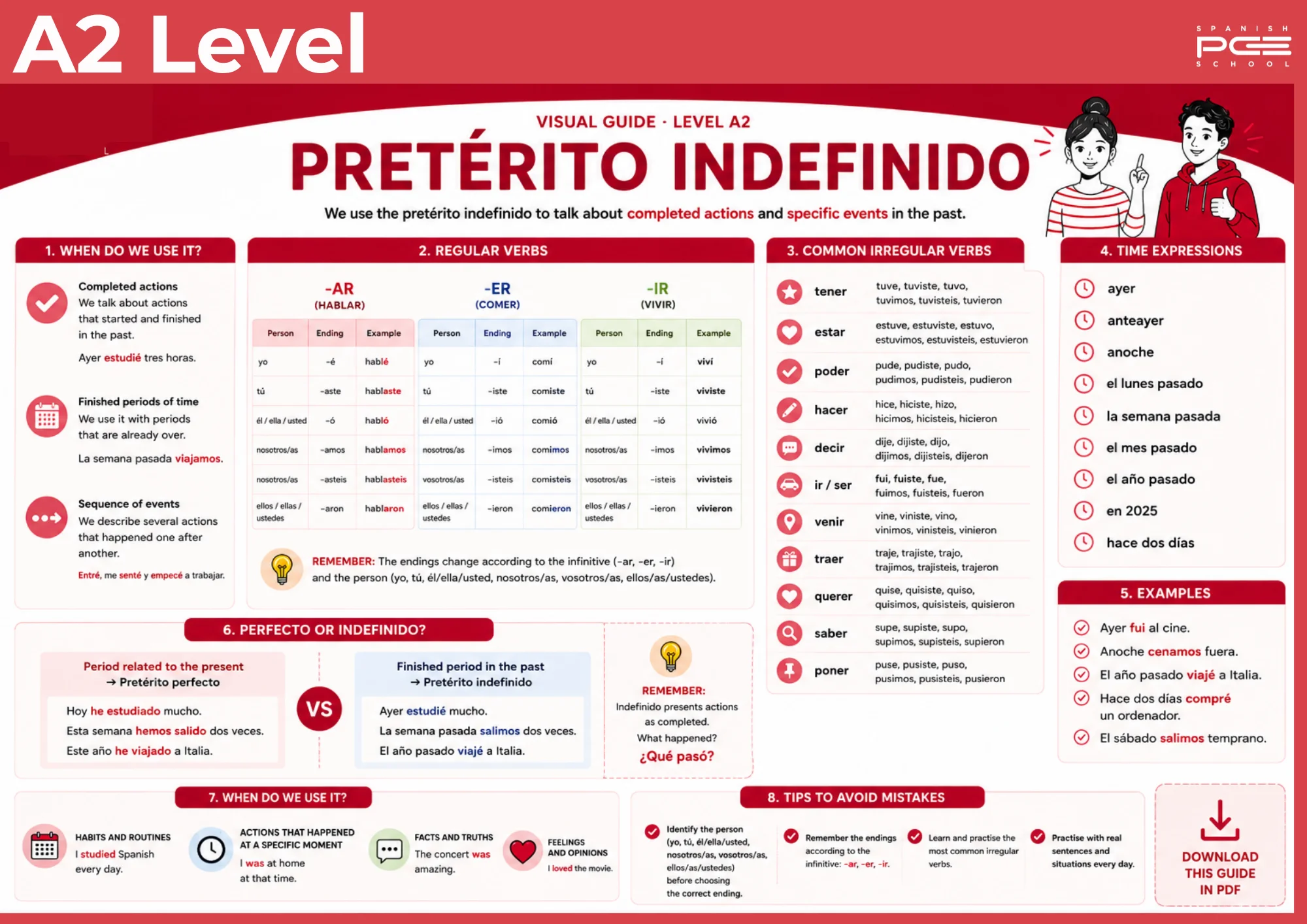
VISUAL GUIDE · LEVEL A2
Preterite tense

Review at a glance how we form and when we use the Spanish preterite tense. Learn the endings of the regular verbs, the most common irregular forms and the time expressions we use to talk about actions completed in the past.

Download the PDF ↓ Free PDF · No registration required
Practise what you have learnt

A2 Preterite Tense Exercises

Now it’s your turn. Complete the following exercises using the Spanish preterite tense. Pay attention to the endings of regular verbs and the forms of the main irregular verbs.

1 Conjugate the regular verbs
2 Recognise the main irregular forms
3 Complete real-life situations and sequences
A2 "Pretérito Indefinido" Exercise
Learn Spanish naturally
Can you conjugate verbs but find it difficult to talk about the past?

Learning the endings is only the first step. To use verb tenses naturally, you need to practise them in real conversations and situations.

At PCE Spanish School you can learn Spanish with specialised teachers and work on grammar, vocabulary and conversation in live online classes.

  • Live online classes
  • Specialised teachers
  • Small groups
  • Real-life conversation practice
  • Grammar and vocabulary
  • Personalised corrections
Spanish class Past tenses and conversation
A2

Complete the sentence:
“Ayer Marta _____ a casa”.

ha llegado llegó llegaba llega
Correct! Ayer Marta llegó a casa.
llegó abrió entró
Avoid these common mistakes

Common mistakes with the preterite tense

Look at some of the most common mistakes when choosing and conjugating the Spanish preterite tense.

Ayer he ido Ayer fui

Ayer he ido al cine.
Ayer fui al cine.

In Spanish as spoken in Spain, with a clearly completed period such as ayer, we normally use the preterite tense.

Yo hablaste Yo hablé

Yo hablaste con María.
Yo hablé con María.

Each person requires the corresponding ending: yo hablé, whereas tú hablaste.

Él hació Él hizo

Juan hació los deberes.
Juan hizo los deberes.

Hacer is irregular in the preterite tense. Its third-person singular form is hizo.

Ellos dijieron Ellos dijeron

Ellos dijieron la verdad.
Ellos dijeron la verdad.

Verbs whose irregular stem ends in -j use -eron: dijeron, not dijieron.

Estuve todos los veranos Estaba todos los veranos

Yo estuve en Madrid todos los veranos de pequeño.
Yo estaba en Madrid todos los veranos de pequeño.

We do not automatically use the preterite simply because we are talking about the past. To express habits and habitual situations we normally use the imperfect tense.

Preterite or imperfect?
Una vez El verano pasado estuve en Madrid.
Habitualmente De pequeño estaba en Madrid todos los veranos.
Your questions answered

Frequently asked questions about the preterite tense

We answer the most common questions about how this past tense is formed and used.

What is the Spanish preterite tense?

It is a past tense that we use mainly to present actions and events as completed.

Ayer compré un libro. El sábado fuimos al cine.
How is the preterite tense formed?

Regular verbs use different endings depending on whether they end in -ar, -er or -ir. There are also many irregular verbs that we need to learn gradually.

hablar → hablé comer → comí vivir → viví
Which irregular verbs are most important?

At A2 level, it is particularly useful to know common forms such as fui, tuve, estuve, hice, pude, puse, vine, quise, dije and traje.

tener → tuve poder → pude hacer → hice decir → dije
What is the difference between “he comido” and “comí”?

In Spanish as spoken in Spain, he comido generally links the action to a period that we consider current. By contrast, comí generally places it within a completed period in the past.

Hoy he comido pasta. Ayer comí pasta.

The use of these tenses can vary between regions of the Spanish-speaking world.

Do ser and ir have the same form in the preterite?

Yes. Both verbs use the forms fui, fuiste, fue, fuimos, fuisteis and fueron. The context tells us which verb is being used.

Fui a Madrid. → ir Fue una experiencia increíble. → ser