Ir a + infinitive
We mainly use it to express plans, intentions and decisions that we have already made.
Voy a estudiar esta tarde.

Learn to talk about plans, intentions and future actions in Spanish and practise with interactive A2 exercises. Discover the most common ways to express the future and learn when to use ir a + infinitive, the present tense and the simple future .
Esta tarde yo _____ español.
Correct! Esta tarde voy a estudiar español.In Spanish, we can talk about the future in different ways. We do not always need to use the simple future.
In fact, in many conversations we use other structures to talk about our plans or things we know are going to happen.
We mainly use it to express plans, intentions and decisions that we have already made.
Voy a estudiar esta tarde.
It can refer to the future when there is a clear time reference or when we are talking about an arranged plan.
Mañana tengo clase.
It allows us to talk about future actions and also express predictions or possibilities.
Algún día viviré en otro país.
One of the most common ways to talk about the future in Spanish is ir a + infinitive. We use this structure especially to express plans, intentions or decisions that we have already made.
| Person | Ir + a | Example |
|---|---|---|
| yo | voy a | voy a estudiar |
| tú | vas a | vas a viajar |
| él / ella / usted | va a | va a trabajar |
| nosotros/as | vamos a | vamos a salir |
| vosotros/as | vais a | vais a comer |
| ellos / ellas / ustedes | van a | van a visitar |
Esta tarde voy a estudiar español.
El sábado vamos a visitar a mis abuelos.
Laura va a buscar un nuevo trabajo.
¿Qué vas a hacer este fin de semana?
In Spanish, we often use the present indicative to talk about future events when there is a clear time reference.
Mañana trabajo.
The verb is in the present tense, but “mañana” places the action in the future.El viernes tenemos un examen.
Este verano viajo a México.
El tren sale a las ocho.
Mañana como con Marta.
El martes tengo una reunión.
El avión sale a las diez.
Este fin de semana vamos a Valencia.
These expressions often appear when we talk about plans and future events and help us clearly indicate when an action will take place.
Esta tarde voy a estudiar.
La semana que viene tenemos un examen.
El próximo año viajaré más.
Dentro de dos días vamos a empezar el curso.
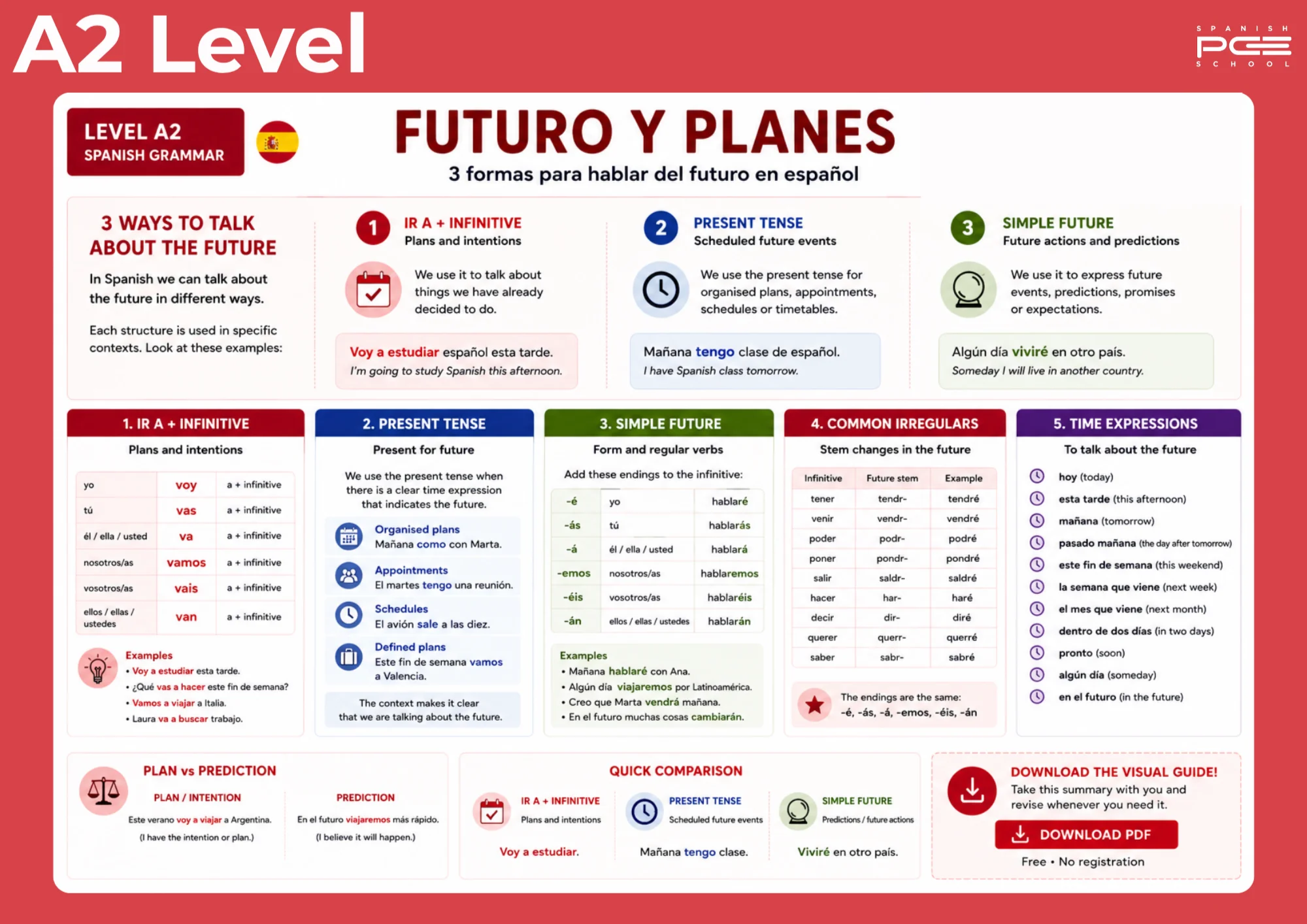
Review visually the main ways to talk about the future in Spanish. Learn how to use ir a + infinitive, the present tense with future meaning and the simple future to express plans, intentions, future events and predictions.
Download PDF ↓ Free PDF · No registration requiredNow it is time to practise. In the following 15 exercises you will work on the main ways of talking about the future covered on this page.
Knowing the structures is important, but the real goal is to be able to use them when you speak.
You may already know that voy a estudiar, mañana trabajo and estudiaré all talk about the future, but you may still have to think too much before choosing a structure. That is completely normal when you are learning Spanish.
At PCE Spanish School we work on grammar through real-life situations so that you can move from understanding a structure to using it naturally.

Review these common mistakes so you can build sentences correctly and choose the right future structure.
Voy a estudio español.
Voy a estudiar español.
After ir a, we always use the infinitive. The second verb is not conjugated.
Voy estudiar esta tarde.
Voy a estudiar esta tarde.
The preposition a is required in this structure.
Mañana trabajo.
Esta noche voy a salir.
In Spanish, we very often use the present indicative y ir a + infinitive to talk about the future. We do not always need forms such as estudiaré, viajaré or comeré.
hablar → hablaré
comer → comeré
vivir → viviré
In the simple future, verbs ending in -ar, -er and -ir use the same endings.
hablararé
hablaré
The ending is added directly to the full infinitive. We do not add a second verb ending.
Review the main ways of expressing plans, intentions and future events.
Ir a + infinitive is one of the most common structures for expressing plans, decisions and intentions.
Yes. It is very common to use the present indicative when there is a clear time reference or when we are talking about an arranged plan.
It is used to talk about future events and is especially useful for expressing predictions, promises or situations that we present as future.
With regular verbs, we add the endings directly to the full infinitive the same endings for verbs ending in -ar, -er and -ir.
The endings are the same, but some verbs use an irregular stem.
Both forms can refer to the future, but they do not always convey exactly the same perspective.
Voy a estudiar usually expresses an intention or plan, whereas estudiaré presents the action as future. Context often determines which sounds more natural.