He comprado el libro. He leído el libro esta tarde.

Learn how to use direct and indirect object pronouns in Spanish and practise with interactive A2 exercises. Discover when to use lo, la, los, las, le and les, where to place the pronouns and how to combine them to avoid repetition and speak more naturally.
He comprado el libro. _____ he leído esta tarde.
When we speak, we often do not want to repeat the name of a person or thing over and over again. Object pronouns allow us to avoid this repetition.
He comprado el libro. He leído el libro esta tarde.
He comprado el libro. Lo he leído esta tarde.
They replace the person or thing that directly receives the action of the verb.
They usually replace the person who receives or benefits from the action.
The direct object (DO) is the person or thing that directly receives the action of the verb. We can identify it by asking a few useful questions.
Marta compra el pan.
¿Qué compra Marta?
El pan
Marta lo compra.
Veo a Laura todos los días.
¿A quién veo?
A Laura
La veo todos los días.
We use these pronouns to replace the person or thing that directly receives the action. In the third person, we need to pay attention to gender and number.
| Person | Pronoun |
|---|---|
| yo | me |
| tú | te |
| él / usted | lo |
| ella / usted | la |
| nosotros/as | nos |
| vosotros/as | os |
| ellos / ustedes | los |
| ellas / ustedes | las |
The pronoun must agree with the person or thing it replaces.
Compro el libro.
Lo compro.
Compro la revista.
La compro.
Compro los libros.
Los compro.
Compro las revistas.
Las compro.
The indirect object (IO) usually indicates the person who receives or benefits from the action.
Marta da un regalo a Carlos .
¿Qué da Marta?
Un regalo
Direct object¿A quién da el regalo?
A Carlos
Indirect objectMarta da un regalo a Carlos.
→Marta le da un regalo.
Escribo un mensaje a mis padres.
Les escribo un mensaje.
These pronouns usually replace the person who receives or benefits from the action.
| Person | Pronoun |
|---|---|
| yo | me |
| tú | te |
| él / ella / usted | le |
| nosotros/as | nos |
| vosotros/as | os |
| ellos / ellas / ustedes | les |
In the third person, we do not distinguish gender, but we do need to distinguish between singular and plural.
Doy el libro a Carlos.
Le doy el libro.
Doy el libro a Marta.
Le doy el libro.
Doy el libro a Carlos y Marta.
Les doy el libro.
Both a Carlos and a Marta are replaced by le.
For one person, we use le. For several people, we use les.
The same sentence can contain both a direct object and an indirect object. To choose the correct pronoun, we need to understand the function of each element.
Ana compra un regalo a su hermano .
¿Qué compra Ana?
Un regalo
Ana lo compra.
“Lo” replaces “el regalo”.¿A quién compra el regalo?
A su hermano
Ana le compra un regalo.
“Le” replaces “a su hermano”.| Feature | Direct object | Indirect object |
|---|---|---|
| Useful question | ¿Qué? / ¿A quién? | ¿A quién? / ¿Para quién? |
| Function | Directly receives the action. | Indicates the recipient or beneficiary. |
| Third person | lo, la, los, las | le, les |
| Example | Ana lo compra. | Ana le compra un regalo. |
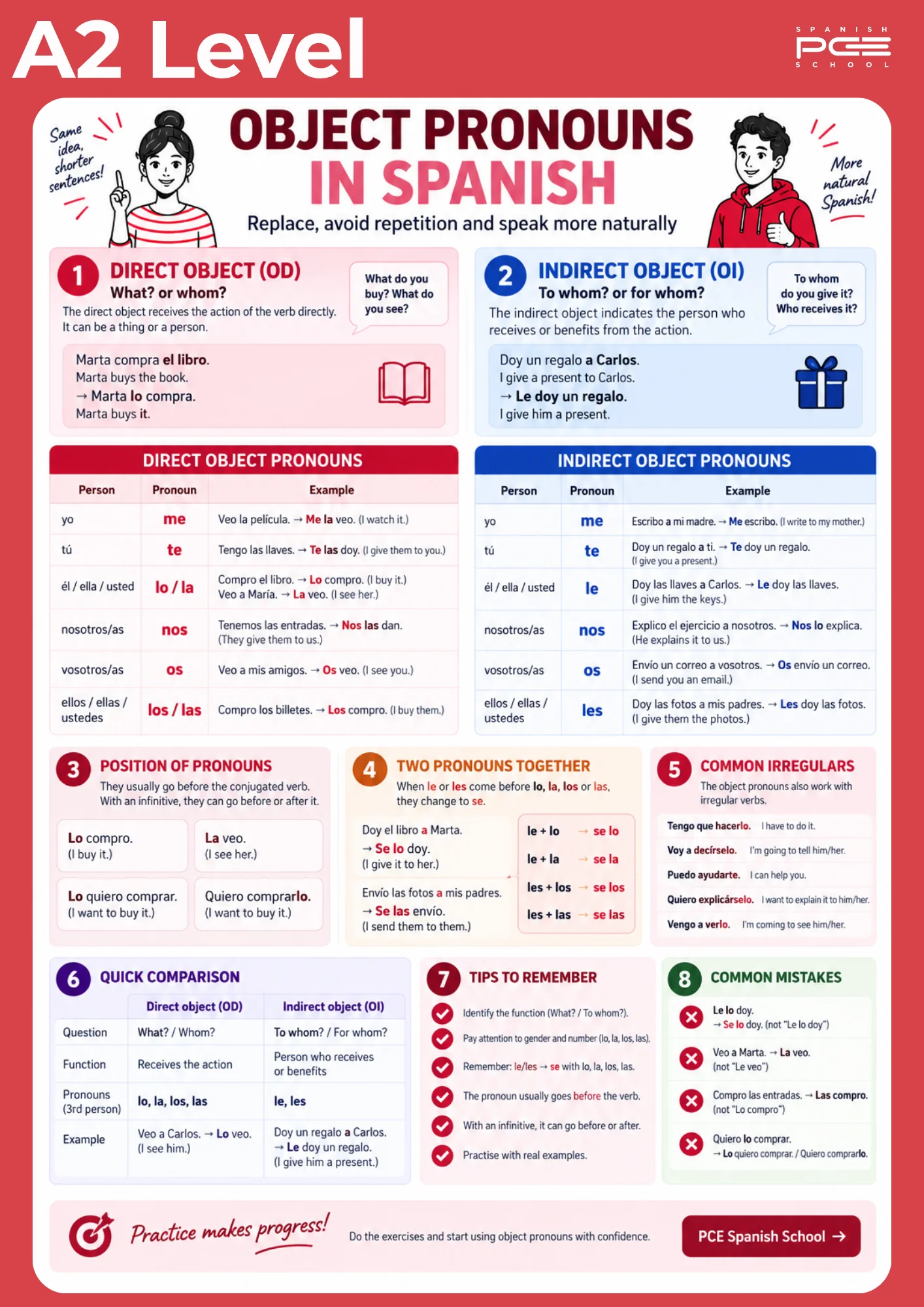
Review visually how to use direct and indirect object pronouns. Learn when to use lo, la, los, las, le and les, where to place the pronouns and how to combine them correctly in structures such as me lo, te la, se lo or se las.
Download PDF ↓ Free PDF · No registration requiredNow it is time to practise. In the following 15 exercises, you will need to identify and use direct and indirect object pronouns correctly.
Read the complete sentence first and identify which element you are replacing before choosing your answer.

Time's up
This is very common. You may understand perfectly well that el libro becomes lo and a Marta becomes le, but during a conversation there is no time to analyse every sentence.
To speak naturally, you need these structures to become increasingly automatic.
At PCE Spanish School, we teach grammar through communicative situations so that you do not just learn the rules, but can actually use them when you speak Spanish.
Learn Spanish with us
¿Has comprado el libro?
Sí, lo he comprado.
¿Has dado el libro a Marta?
Sí, se lo he dado.
Review these common mistakes to help you choose the correct pronoun and place it correctly in the sentence.
He comprado el libro y después he leído el libro.
He comprado el libro y después lo he leído.
The first sentence is possible, but if we already know which book we are talking about, it is more natural to use lo.
Veo a Marta.
→ La veo.
Doy un libro a Marta.
→ Le doy un libro.
In the first sentence, Marta directly receives the action of the verb ver. In the second, she is the recipient of the book.
Compro las entradas. → Lo compro.
Compro las entradas. → Las compro.
The direct object pronoun must agree in gender and number with the element it replaces.
Le lo doy.
Se lo doy.
When le or les appear before lo, la, los or las, they change to se.
Lo quiero comprar.
Quiero comprarlo.
Quiero lo comprar.
With a conjugated verb followed by an infinitive, we can place the pronoun before the conjugated verb or attach it to the infinitive, but never between the two verbs.
Review the differences, forms and position of direct and indirect object pronouns.
The direct object directly receives the action of the verb, while the indirect object usually indicates the recipient or beneficiary of that action.
We mainly use them as third-person direct object pronouns. They agree in gender and number with the element they replace.
We use them as third-person indirect object pronouns. Le is used for the singular and les for the plural.
Because le and les change to se when they appear before lo, la, los or las.
With a conjugated verb, it normally goes before it: Lo compro. With an infinitive, it can be attached to the end: Quiero comprarlo.
In structures such as ir a + infinitive, both positions are possible.
No. A person functioning as a direct object may take the personal a. For this reason, we should not automatically identify a + person as an indirect object.
Utilizamos cookies propias y de terceros para analizar la navegación, mejorar nuestros servicios y garantizar el correcto funcionamiento de la web. Puede aceptar todas las cookies, rechazarlas o configurarlas. Puedes conocer más en Política de cookies.