
Spanish grammar · Level A2

A2 Present Perfect Exercises

Learn how to form and use the Spanish present perfect and practise with interactive A2-level exercises. Work with regular and irregular participles, learn when this tense is used and check your answers instantly.

Start the 15-question exercise Free · Instant result
Choose the correct option

Esta semana nosotros _____ tres clases.

hemos tenido tenemos hemos tener
Correct! Esta semana hemos tenido tres clases.
A2 level Interactive exercises Free online practice
Key concept

What is the present perfect?

The present perfect is formed and when we use it is a verb tense used to talk about past actions that have some relationship with the present.

A past connected to the present

The action happened before the moment we are speaking, but we place it within a period that we still consider current.

This period can be today, this week or even our whole life experience up to now.

Hoy Hoy he hablado con María. The day is not over yet.
Esta semana Esta semana hemos tenido tres clases. The week is considered a current period.
Hasta ahora ¿Alguna vez has visitado Sevilla? We are asking about a life experience.
Auxiliary verb haber
Main verb participle
For example: he estudiado · has comido · hemos vivido
Formation

How the present perfect is formed

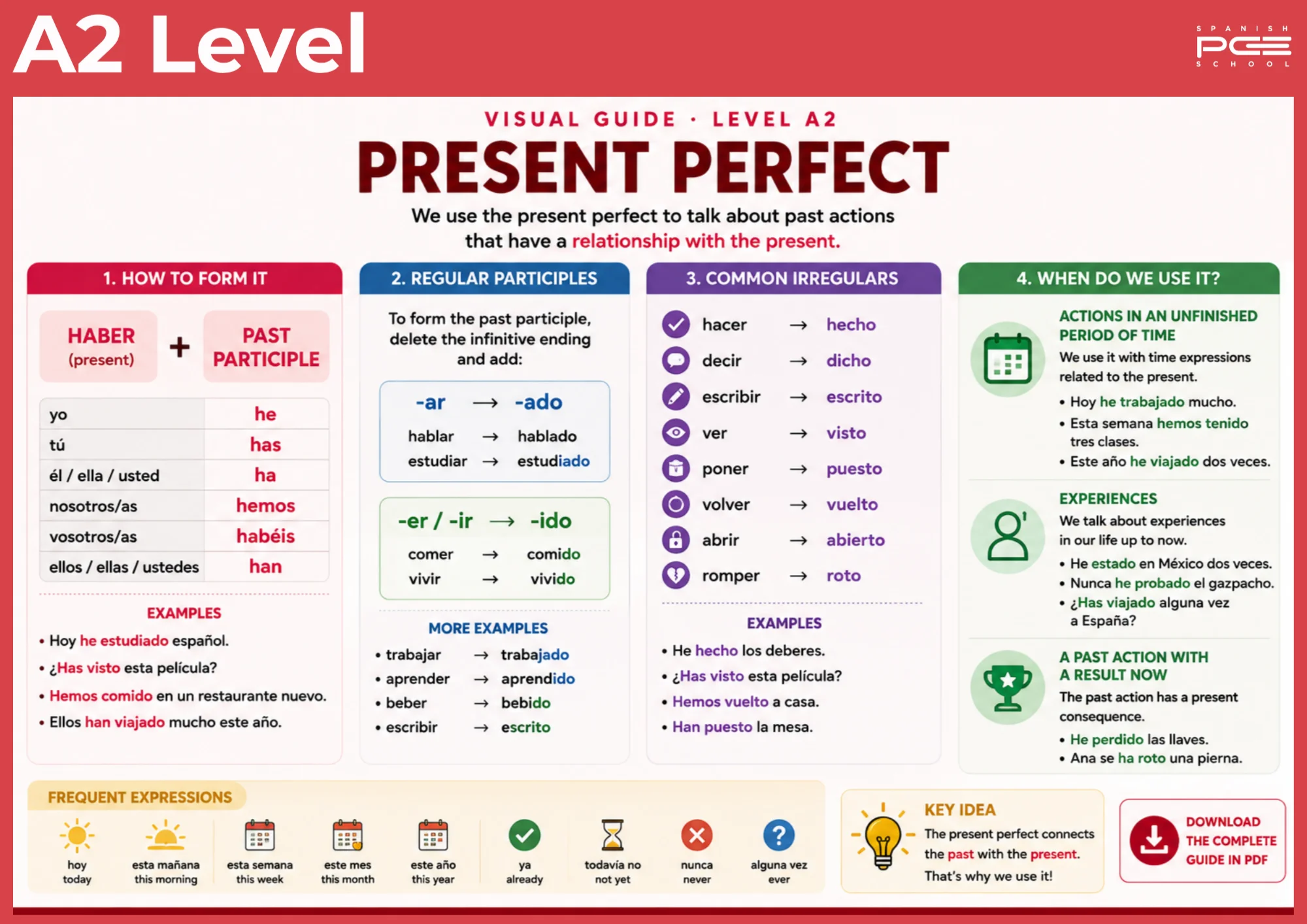
To form the present perfect we need the verb present tense of haber and the participle of the main verb.

Present tense of haber Participle Present perfect
Step 1

The verb haber

We conjugate haber according to the subject.

Person Haber
yo he
has
él / ella / usted ha
nosotros/as hemos
vosotros/as habéis
ellos / ellas / ustedes han
Yo he estudiado español.
has comido paella.
Ellos han vivido en Madrid.
Step 2

Regular participles

We remove the infinitive ending and add -ado or -ido.

Swipe sideways to view the table
Infinitive Ending Participle
hablar -ar → -ado hablado
comer -er → -ido comido
vivir -ir → -ido vivido
Other examples
estudiar estudiado trabajar trabajado aprender aprendido beber bebido
Special forms

Irregular participles

Some frequent verbs do not form the participle following the rules of -ado and -ido. Therefore, we need to learn their irregular forms.

hacer hecho
Infinitive Irregular participle
hacer hecho
decir dicho
escribir escrito
ver visto
poner puesto
volver vuelto
abrir abierto
romper roto
Examples in context
He hecho los deberes.
¿Has visto esta película?
Marta ha escrito un correo.
Hemos vuelto a casa.
Main uses

When do we use the present perfect?

We use this tense to connect a past action with a period, an experience, or a present consequence.

01 Current period

Actions within an unfinished period

We are talking about actions that occurred within a period that we still consider current.

Hoy he trabajado mucho.

Esta semana hemos estudiado los pasados.

Este año he viajado dos veces a España.

02 Hasta ahora

Experiences

We express experiences we have had — or have not had — at some point in our lives up to the present.

alguna vez nunca ya todavía no

He estado en México dos veces.

Nunca he probado el gazpacho.

¿Has viajado alguna vez a España?

03 Consequence

Past actions with a present result

The action happened earlier, but its result remains relevant at the present moment.

He perdido las llaves. Ahora no tengo las llaves.
Ana se ha roto una pierna. The consequence continues into the present.

Note: the use of the present perfect and the simple past can vary by region. These uses are especially frequent in the Spanish of Spain.

Time markers

Frequent words with the present perfect tense

These expressions appear very frequently with the present perfect and help us establish its connection to the present.

hoy esta mañana esta semana este mes este año ya todavía no nunca alguna vez últimamente

Current time periods

hoy esta semana este mes este año

They set the action within a period that we still consider unfinished.

Experiences and completed actions

alguna vez nunca ya todavía no

Indicate whether an experience or an action has occurred to the present moment.

Ya / todavía no
¿Has desayunado ya? No., todavía no he desayunado.
Alguna vez / nunca
¿Has estado alguna vez en Barcelona? No., nunca he estado allí.
Current period

Esta semana hemos tenido mucho trabajo.

VISUAL GUIDE · LEVEL A2
Present perfect

Review at a glance how we form and when we use the present perfect is formed and when we use it. Learn the structure haber + participio, the most frequent regular and irregular participles and the expressions that usually accompany this verb tense.

Download the PDF ↓ Free PDF · No registration required
Practise what you have learnt

A2 Present Perfect Exercises

Now it's your turn. Complete the following exercises using the present perfect correctly. Pay attention to the correct form of haber, the participle and irregular participles.

1 Choose the correct form of the verb haber
2 Form regular and irregular participles
3 Complete real-life situations in Spanish
A2 "Pretérito Perfecto" Exercise
Learn Spanish naturally
Do you know the verb tenses but struggle to use them when you speak?

Learning the rules is only part of the process. To use the past tense naturally, you need practise it in real conversations and situations.

At PCE Spanish School you can learn Spanish with specialised teachers and work on grammar, vocabulary and conversation in live online classes.

  • Live online classes
  • Specialised teachers
  • Small groups
  • Real communicative situations
  • Grammar and vocabulary
  • Personalised corrections
Spanish class Past tenses and conversation
A2

Complete the sentence:
“Marta ya _____ los deberes”.

ha hacido ha hecho es hecho ha hacer
Correct! Marta ya ha hecho los deberes.
ha + hecho = present perfect is formed and when we use it
Avoid these common mistakes

Frequent mistakes with the present perfect

These are some of the most common mistakes when forming the present perfect is formed and when we use it. Look at the correction and remember the rule in each case.

He comer He comido

Hoy he comer en casa.
Hoy he comido en casa.

After the verb haber we need a participle, not an infinitive: comer → comido.

Soy estudiado He estudiado

Soy estudiado español.
He estudiado español.

The present perfect is constructed with the auxiliary verb haber, not with the verb ser.

He hacido He hecho

He hacido los deberes.
He hecho los deberes.

The verb hacer has an irregular participle that we must memorise: hacer → hecho.

Hemos comidas Hemos comido

Hemos comidas dos pizzas.
Hemos comido dos pizzas.

When it appears with haber, the participle does not change according to gender or number. We always say he comido or hemos comido.

Your questions answered

Frequently asked questions about the present perfect tense

We review the most common doubts about the formation and uses of this verb tense.

How is the present perfect formed?

It is formed using the present tense of the verb haber followed by the participle of the main verb.

he hablado has comido hemos vivido
When is the present perfect used?

It is mainly used to talk about experiences related to the present, or actions that take place within a period of time that we still consider current.

Hoy he trabajado mucho. He estado en México dos veces.
What are the most frequent irregular participles?

Some of the most common irregular participles are hecho, dicho, visto, escrito, puesto, vuelto, abierto and roto.

hacer → hecho see → seen escribir → escrito put
Does the participle change in masculine and feminine?

No. When you form the present perfect with haber, the participle remains invariable and does not agree with the person performing the action.

María ha llegado. Pedro ha llegado. María y Ana han llegado.
What is the difference between “he comido” and “comí”?

Both forms talk about the past, but they are not used in exactly the same way. Generally speaking, he comido relates the action to the present or to a period that we consider current.

On the other hand, comí usually sets the action in a past period that we consider finished. This difference can vary depending on the region and is studied in more detail when comparing past tenses.

Hoy he comido en casa. Ayer comí en casa.