Madrid es más grande que Toledo.

Learn how to compare people, objects and situations in Spanish and practise with interactive A2 exercises. Work with structures such as más... que, menos... que and tan... como , discover how to form superlatives and learn how to express different quantities with mucho, poco, bastante and demasiado .
Marta es _____ alta como Laura.
We make comparisons all the time: we can compare the height of two people, the price of two products, two cities, two jobs or even two ways of learning Spanish.
Madrid es más grande que Toledo.
Este ejercicio es menos difícil que el anterior.
Marta es tan alta como Laura.
In all three examples, we are comparing two elements, but the relationship between them is different. In Spanish, we use different structures to express superiority, inferiority or equality.
The three main structures
| Comparison | Structure | Example |
|---|---|---|
| Superiority | más + adjetivo + que | Ana es más alta que Marta. |
| Inferiority | menos + adjetivo + que | Este coche es menos caro que aquel. |
| Equality | tan + adjetivo + como | Luis es tan alto como Carlos. |
We use this structure when a person, object or situation has a quality to a greater degree than another.
Mi casa es más grande que la tuya.
Marta habla más rápido que Carlos.
Este libro es más interesante que el otro.
We can also use más... que to express that there is a greater quantity of something.
Tengo más libros que tú.
En Madrid hay más tráfico que en mi ciudad.
We use this structure when a person, object or situation has a quality or quantity to a lesser degree than another.
Este ejercicio es menos difícil que el anterior.
Mi barrio es menos ruidoso que el centro.
Ana conduce menos rápido que Pedro.
We also use menos... que to express that there is a smaller quantity of something.
Tengo menos tiempo que tú.
Esta casa tiene menos habitaciones que la otra.
When two elements have a characteristic to the same degree, we use the structure tan... como.
Marta es tan alta como Laura.
Este examen es tan difícil como el anterior.
Carlos habla tan rápido como Ana.
Marta es tan alta que Laura.
Marta es tan alta como Laura.
We use the relative superlative to highlight a person, object or situation within a group.
Ana es más alta que Marta.
Ana es la más alta de la clase.
Carlos es el más alto de la familia.
Esta es la ciudad más bonita de la región.
Son los ejercicios más difíciles de la unidad.
Marta es la menos tímida del grupo.
The article and adjective must agree in gender and number with the person or thing being highlighted.
Before doing the exercises, review the main structures for making comparisons, expressing intensity and talking about quantities.
| I want to express... | Structure | Example |
|---|---|---|
| Superiority | más... que | Es más alto que yo. |
| Inferiority | menos... que | Es menos caro que este. |
| Equality | tan... como | Es tan rápido como tú. |
| Equality of quantity | tanto/a/os/as... como | Tiene tantos libros como yo. |
| Irregular comparative | mejor / peor | Este es mejor que aquel. |
| Superlative | el / la más... de | Es la más alta de la clase. |
| Intensity | muy + adjetivo | Es muy alto. |
| Quantity | mucho / poco / bastante / demasiado | Tengo mucho trabajo. |
Más and menos Comparatives of superiority and inferiority end with que.
Tan and tanto Use tan with adjectives and tanto/a/os/as with nouns.
Muy and mucho Use muy with adjectives and mucho/a/os/as with nouns.
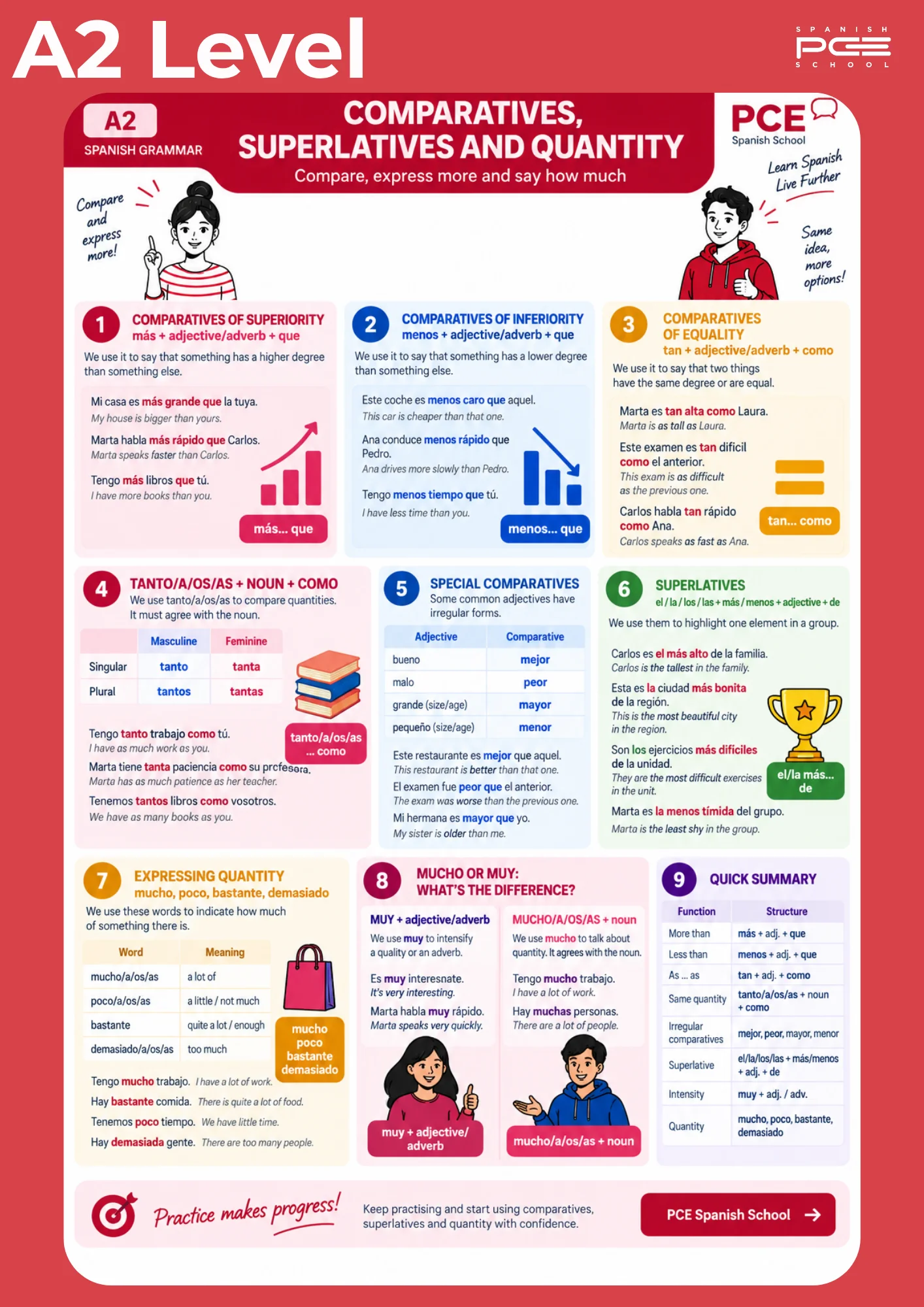
Review visually how to compare people, objects and situations in Spanish. Learn how to use más... que, menos... que, tan... como, structures with tanto/a/os/as, superlatives and quantity expressions such as mucho, poco, bastante and demasiado.
Download PDF ↓ Free PDF · No registration requiredIn the following 15 exercises, you will practise the main structures we use to make comparisons and express degrees and quantities in Spanish.

Time's up
Knowing that más alto que expresses superiority or that tan alto como expresses equality is only the first step.
When you speak Spanish, you need to use these structures without first building the sentence in your own language. At PCE Spanish School, we work on grammar through conversations and real-life situations.

Complete the sentence:
“Esta opción es _____ que la anterior”.
These are some of the most common mistakes when using comparatives, superlatives and quantity expressions in Spanish.
Marta es más alta de Laura.
Marta es más alta que Laura.
Comparatives of superiority and inferiority are formed with más or menos + que.
Es tan interesante que el otro.
Es tan interesante como el otro.
To express equality, we use the structure tan + adjective or adverb + como.
Tengo tan libros como tú.
Tengo tantos libros como tú.
We use tan with adjectives and adverbs: tan interesante como. We use tanto/a/os/as with nouns: tantos libros como.
Este restaurante es más bueno.
Este restaurante es mejor.
Esta opción es más mala.
Esta opción es peor.
The usual comparative forms of bueno and malo are mejor and peor.
Es mucho interesante.
Es muy interesante.
Tengo muy trabajo.
Tengo mucho trabajo.
We use muy before adjectives and adverbs. We use mucho/a/os/as before nouns.
Hay mucho personas.
Hay muchas personas.
Tenemos demasiado tareas.
Tenemos demasiadas tareas.
When used with a noun, mucho, poco, tanto and demasiado agree with it in gender and number.
Review the most common questions about comparatives, superlatives and quantity expressions in Spanish.
We normally use más + adjective or adverb + que .
Marta es más alta que Ana.
Tan is used with adjectives or adverbs. Tanto/a/os/as can be used with nouns and must agree with them in gender and number.
Es tan alto como su padre. Tiene tantos libros como yo.
For the general comparison studied at A2 level, we normally use the irregular comparative mejor.
Este libro es mejor que aquel.
To highlight one element within a group, we can use el/la/los/las + más or menos + adjective + de .
Ana es la más alta de la clase.
Muy usually modifies adjectives and adverbs. Mucho can be used with nouns or modify verbs.
Es muy interesante. Tengo mucho trabajo. Trabajo mucho.
It indicates that a quantity or degree of intensity exceeds what we consider necessary, appropriate or desirable.
Hay demasiada gente. Pedro trabaja demasiado.
You have reached the last exercise in this section. Keep reviewing the other A2 topics to consolidate what you have learnt.
Utilizamos cookies propias y de terceros para analizar la navegación, mejorar nuestros servicios y garantizar el correcto funcionamiento de la web. Puede aceptar todas las cookies, rechazarlas o configurarlas. Puedes conocer más en Política de cookies.